

The Mental Health Debt Building Across Australia’s Supply Chains

By Steven Ballerini | CEO of Australasian Supply Chain & Logistics Association (ASCLA)
Australia’s transport, postal and warehousing sector leads on physical safety. Incidents are tracked, hazards are controlled, and near-miss reporting is embedded across the industry. That culture has taken decades to build and the sector is right to be proud of it.
On workplace mental health and wellbeing, the sector ranks last out of 19 Australian industries. That ranking has not materially improved in successive years of national measurement.
The pressures experienced by workers across supply chain and logistics are not new. What is less understood is how clearly the numbers reflect it, and where the pressure is actually being generated.
What the Data Shows
The idea that mental health sits outside the operational conversation has never held up to scrutiny. A decade of claims data has made that plain.
Serious mental health condition claims have risen by 161.1 percent over the ten years to 2023-24, the largest increase of any injury category recorded by Safe Work Australia. They now represent 12 percent of all serious workers’ compensation claims nationally – 17,600 claims in a single year.
The cost profile separates mental health claims from every other category. According to Safe Work Australia’s Key Work Health and Safety Statistics Australia 2025, the median compensation paid for a psychological injury claim is $67,400, compared with $16,300 across all serious claims. The median time off work is 35.7 working weeks for a mental health claim, against 7.4 weeks across all serious claims.
For transport, postal and warehousing specifically, the sector recorded 9.0 serious claims per million hours worked, against a national all-industry rate of 6.8 – placing it well above average across all injury and disease types.
Why This Industry Carries a Different Kind of Risk
A national cross-sectional study of 1,390 Australian truck drivers, conducted by researchers at Monash University and published in BMC Public Health, found that 50 percent reported moderate to severe psychological distress. Nearly one in five – 19.4 percent – reported a diagnosed mental health condition.
These findings reflect associations between working conditions in this sector and psychological distress outcomes. They are not isolated results. They are consistent with what the broader claims data shows.
The Structural Conditions That Drive Distress
The risk factors in transport and logistics are specific and well-documented. They include:
- Long shifts with limited recovery time between cycles
- Solo work environments with extended periods of isolation
- Unpredictable or rotating rosters that disrupt sleep and family routines
- Tight delivery windows that remove the ability to manage pace
- High exposure to road trauma and critical incidents
- Limited access to peer support, particularly for long-haul and regional workers
Research has identified heavy workloads, long hours, isolation, unclear roles, higher exposure to trauma and limited management support as the primary contributors to stress, burnout and high turnover across the sector. None of those conditions resolve without deliberate intervention.
Where the Decisions Are Made
The roster is written in an office. The delivery window is set in a contract. The staffing level in a warehouse is approved in a budget. The culture of a depot is set by whoever manages it, and shaped by whoever manages above them.
This is where the conversation about mental health in the supply chain needs to sit. The conditions associated with psychological distress in this sector are largely created upstream of the people experiencing them. So are the solutions.
What Leaders Can Do
Research on effective psychosocial risk management points consistently in the same direction: early identification of hazards, practical controls at the system level, and cultures where people can raise concerns before they reach a point of crisis.
Healthy Heads in Trucks & Sheds is the national not-for-profit dedicated specifically to psychological safety and physical wellbeing across Australia’s transport, warehousing and logistics sectors. Built by the industry, for the industry, Healthy Heads provides free resources, mental health training tailored to the sector, a wellbeing app, and structured programs to help employers build safer working environments.
In 2026, Healthy Heads launched the Healthy Heads Thrive program – an industry-first psychosocial risk management pilot developed in collaboration with AP Psychology & Consulting Services and Gallagher Bassett. The program gives employers a structured way to identify workplace hazards, assess risks and implement controls before issues escalate into formal claims.
Healthy Heads has also developed the Roadmap Planner, a practical tool built on the National Mental Health and Wellbeing Roadmap, to help businesses of all sizes establish a Workplace Wellbeing Plan and meet their work health and safety duty of care.
Safe Work Australia draws a clear distinction between two types of response. The first is controlling how work is designed and managed – roster structure, workload, role clarity, management support and contact with isolated workers. The second is support services such as EAPs and counselling, which help people after distress or harm has already occurred. Both matter. But support services alone do not discharge an employer’s obligation to eliminate or minimise psychosocial risks at their source.
The practical actions that reduce psychosocial risk in this sector include:
- Roster design that accounts for fatigue and genuine recovery, not just operational coverage
- Clear role expectations so workers understand what is and is not in scope for them
- Management capability to have early conversations, not just manage formal complaints
- Regular contact with isolated workers, particularly those in long-haul or sole-operator roles
- Access to confidential support as part of a broader wellbeing plan, not as a substitute for one
ASCLA has partnered with Healthy Heads in Trucks & Sheds to continue this conversation with the industry.
On 8 September 2026, ASCLA CEO Steven Ballerini and Healthy Heads CEO Naomi Frauenfelder will host a free webinar, We Need to Talk About the Other Half of Safety: Mental Health in Supply Chain & Logistics.
The session will look at what the data shows, where workplace pressures are being created, and the practical steps leaders can take to reduce psychosocial risk.
The webinar is free to attend, includes a moderated Q&A, and will be recorded for everyone who registers. Register for the webinar before registrations close at noon on 7 September 2026.
The Final Word
Median compensation for mental health condition claims is more than four times the median across all serious claims, and the volume is still growing. Workforce retention in transport and logistics is already under pressure from multiple directions. Every worker who leaves because of burnout or unmanaged distress takes experience with them and adds direct cost to the organisations they leave behind.
The sector cannot continue treating mental health as a welfare issue that runs parallel to the operational agenda. The data has been making the business case for years.
ASCLA and Healthy Heads in Trucks & Sheds’ partnership aims at improving mental health and wellbeing outcomes across Australia’s supply chain and logistics workforce. If your role influences how people in this sector work, this conversation is worth your time. Register for the webinar today.
Resources
- SuperFriend, Indicators of a Thriving Workplace 2025 – Australia’s most comprehensive workplace mental health survey, measuring performance across five domains across 19 industries. superfriend.com.au
- Van Vreden, C., Xia, T., Collie, A. et al., The physical and mental health of Australian truck drivers: a national cross-sectional study, BMC Public Health 22, 464 (2022). doi.org/10.1186/s12889-022-12850-5
- Safe Work Australia, Key Work Health and Safety Statistics Australia 2025 – national workers’ compensation claims data by industry and injury type. safeworkaustralia.gov.au/collection/key-work-health-and-safety-statistics
- Xia, T., Pritchard, E., van Vreden, C. et al., Factors associated with psychological distress among Australian truck drivers, Journal of Transport & Health, Vol. 41, March 2025. doi.org/10.1016/j.jth.2024.101973
- Safe Work Australia, Psychosocial hazards guidance for employers – obligations and controls for eliminating and minimising psychosocial risks. safeworkaustralia.gov.au/safety-topic/managing-health-and-safety/mental-health/psychosocial-hazards
- Healthy Heads in Trucks & Sheds – free resources, wellbeing app, mental health training, and the Healthy Heads Thrive psychosocial risk management pilot for transport and logistics employers. healthyheads.org.au
- Lifeline – 24-hour crisis support. Call 13 11 14 or visit lifeline.org.au
- Beyond Blue – mental health support and information. beyondblue.org.au
View Similar Blogs
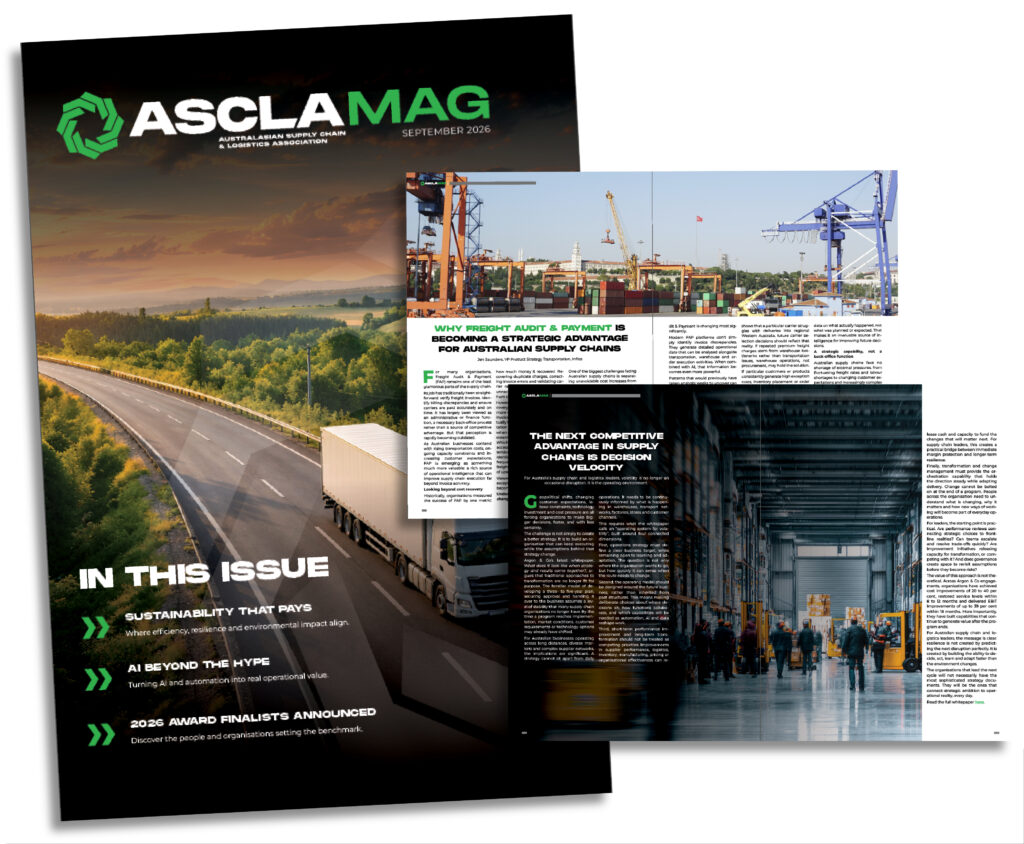
ASCLA Mag September 2026
The September 2026 edition of ASCLA Mag explores how sustainability is becoming a practical business advantage across Australasia’s supply chain and logistics industry. As AI, data and operational innovation reshape how goods are planned, moved and delivered, this edition examines the strategies helping organisations reduce waste, improve efficiency, strengthen freight resilience and build the workforce…

Data Centres and the Squeeze on Logistics Land
By Steven Ballerini | CEO of Australasian Supply Chain & Logistics Association (ASCLA) For most of the past decade, the competition for industrial land on the fringes of Sydney and Melbourne was a contest between logistics operators, manufacturers and the developers who built for them. That contest has acquired a new and considerably better-funded participant.…
Celebrating an Industry That Rarely Celebrates Itself
By Steven Ballerini | CEO of Australasian Supply Chain & Logistics Association (ASCLA) On Friday 23 October the industry will gather at Brisbane City Hall for the ASCLA Industry Awards, and for the first time in more than six decades of the awards the night will be held in Brisbane. Six decades is a long…