

Celebrating an Industry That Rarely Celebrates Itself
By Steven Ballerini | CEO of Australasian Supply Chain & Logistics Association (ASCLA)
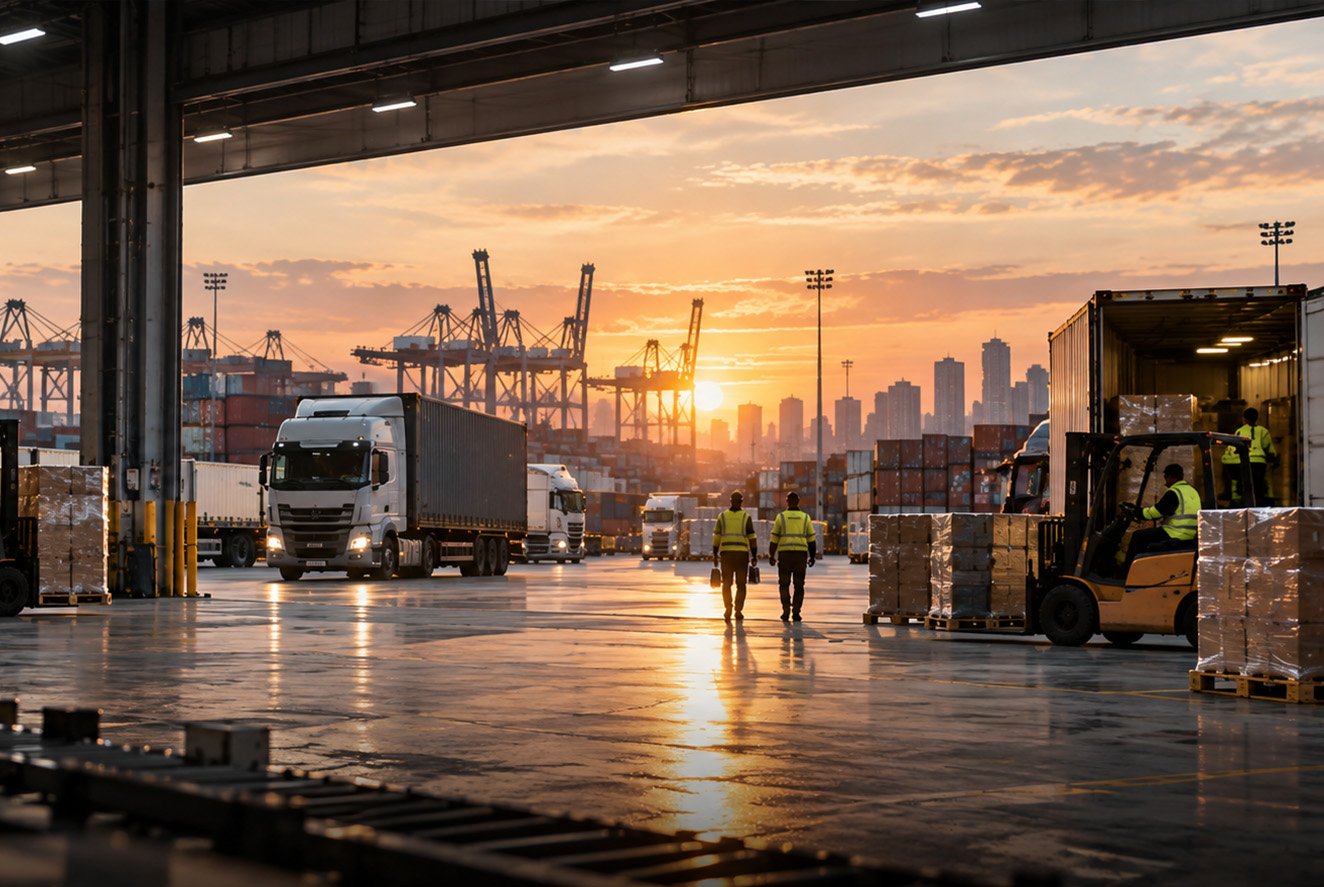
On Friday 23 October the industry will gather at Brisbane City Hall for the ASCLA Industry Awards, and for the first time in more than six decades of the awards the night will be held in Brisbane. Six decades is a long run for anything in this sector. The awards were first presented when the national freight task was a fraction of what it is today, and they have since outlasted containerisation, deregulation, the barcode, the arrival of the distribution centre as we now understand it, and more restructures than anyone would care to count. What has not changed in all that time is the reason they exist. Supply chain is the most important job most people never think about, and an industry that becomes invisible precisely when it is working well has to do its own noticing.
Recognition Is Not a Nicety
There is a tendency in operational businesses to treat recognition as the soft end of the people agenda, something that happens after the real work is done and the budget allows. The evidence does not support that reading. Gallup research published in 2024, drawing on employee data collected between 2022 and 2024, found that employees who received what it classified as high-quality recognition were 45 per cent less likely to have left their organisation two years later, and that those whose recognition met at least four of Gallup’s five pillars of strategic recognition were 65 per cent less likely to be actively looking for another job. The same research found that only 22 per cent of employees felt they received adequate recognition for the work they did, a figure that had not moved since 2022.
Set that against the scale of our own workforce and the arithmetic becomes hard to ignore. Jobs and Skills Australia reported in March 2026 that transport, postal and warehousing employs 754,500 people in Australia, or 5.1 per cent of the total workforce, having grown by 15,300 people over the preceding year. In a sector that competes for labour with every other industry and has spent the better part of a decade discussing how to attract and keep people, a mechanism that measurably improves the odds of good people staying is not a nicety. It is a retention instrument that costs very little to operate.
Why Awards Do More Than Reward
The deeper argument for industry awards has less to do with the individuals who collect them and more to do with what happens to everyone watching. Everett Rogers set out the framework in Diffusion of Innovations in 1962, and the central insight has held up remarkably well: an innovation does not spread on merit alone, but on how observable and how trialable it is to the people who might adopt it next. A brilliant improvement that nobody outside the business can see does not diffuse. A good improvement that is documented, quantified and put in front of peers does.
That is the real work an awards program performs. Preparing a submission forces an organisation to baseline what it was doing before, quantify what changed, and explain the method in terms a stranger can follow, which is the same discipline that good operators apply internally and almost never write down. Judging then subjects that account to scrutiny by people who know the difference between a genuine result and a well-presented one. What emerges is a body of verified, public examples that the rest of the industry can examine and copy, which is how practice actually moves across a sector rather than within a single firm.
The Progress Is Real and It Is Measurable
It is worth being specific about what this industry has been achieving, because the day-to-day rarely leaves room to notice. The Bureau of Infrastructure and Transport Research Economics, in its Australian Infrastructure and Transport Statistics Yearbook 2025 published in December 2025, put the domestic freight task at an estimated 786 billion tonne kilometres in 2024–25, its highest recorded level, recovered from the pandemic trough of 760 billion tonne kilometres in 2020–21 and above the 780 billion recorded in 2018–19. The sector is moving more freight than it ever has, and doing so while absorbing cost pressure, labour constraint and a customer expectation of delivery performance that would have been considered unreasonable a decade ago.
The investment behind that performance is equally visible. IMARC Group valued Australia’s logistics automation market at US$1.82 billion in 2025 and forecasts it will reach US$4.37 billion by 2034, a compound annual growth rate of 10.23 per cent across the forecast period. Those are not the numbers of an industry standing still, and they represent thousands of individual decisions by operators to back a business case, retrain a workforce and carry the disruption of implementation. Most of those projects will never be written up anywhere. A handful of them will be on stage in Brisbane.
The Categories Are a Map of Where the Effort Is Going
The 2026 program spans ten categories, and read together they function as a reasonable summary of where the industry is putting its energy. Alongside the long-standing Supply Chain Management, Transport and Logistics Excellence and Industry Excellence categories sit Automation, Robotics or Emerging Technology; Big Data, IT and Business Intelligence; Environmental Excellence; International Supply Chain; Workplace Health and Safety; Training, Education and Development; Start-Up; and Future Leaders, which recognises individuals aged 30 or under. Several of those categories would have made little sense to the industry twenty years ago, which is itself the point. The Future Leaders category in particular does something the others cannot, which is to tell a young professional early in their career that this sector is worth staying in.
Friday 23 October, Brisbane City Hall
The gala dinner begins at 6.30pm on Friday 23 October at Brisbane City Hall, with Oracle NetSuite as the 2026 Platinum Sponsor, and tables are moving quickly. My encouragement to members is straightforward. If your organisation has a team that delivered something difficult this year, bring them, and not only the executives who signed it off. The value of the night is not in the trophies but in several hundred people from across the sector being in one room acknowledging that the work is hard, that it matters, and that somebody noticed. That is a rarer experience in this industry than it should be, and it is the one thing an awards night can produce that a report never will.
Book your place now at www.ascla.com.au. I look forward to seeing you there!
Sources: Gallup, “Employee Retention Depends on Getting Recognition Right”, 2024, reporting employee data collected 2022–2024 (45 per cent lower turnover, 65 per cent lower active job seeking, 22 per cent adequate recognition). Jobs and Skills Australia, Transport, Postal and Warehousing industry profile, current as at March 2026 and based on February 2026 Labour Force Survey data (754,500 employed, 5.1 per cent of the workforce, growth of 15,300 over the year). Bureau of Infrastructure and Transport Research Economics, Australian Infrastructure and Transport Statistics Yearbook 2025, December 2025 (786 billion tonne kilometres in 2024–25; 780 billion in 2018–19; 760 billion in 2020–21). IMARC Group, Australia Logistics Automation Market report, base year 2025 (US$1.82 billion in 2025, forecast US$4.37 billion by 2034 at a CAGR of 10.23 per cent for 2026–2034). Everett M. Rogers, Diffusion of Innovations, first published 1962. ASCLA, 2026 Industry Awards category list, gala dinner details and sponsor information, ascla.com.au and ascla.org, accessed September 2026.
View Similar Blogs

Why Transport Belongs at the Centre of Australia’s Innovation Agenda
By Steven Ballerini | CEO of Australasian Supply Chain & Logistics Association (ASCLA) In August, ASCLA joined 23 other national organisations spanning rail, road, heavy vehicles, freight, logistics, engineering and research in a joint letter to Senator the Hon Tim Ayres, Minister for Industry and Innovation and Minister for Science, asking the Australian Government to…
ASCLA Mag September 2026
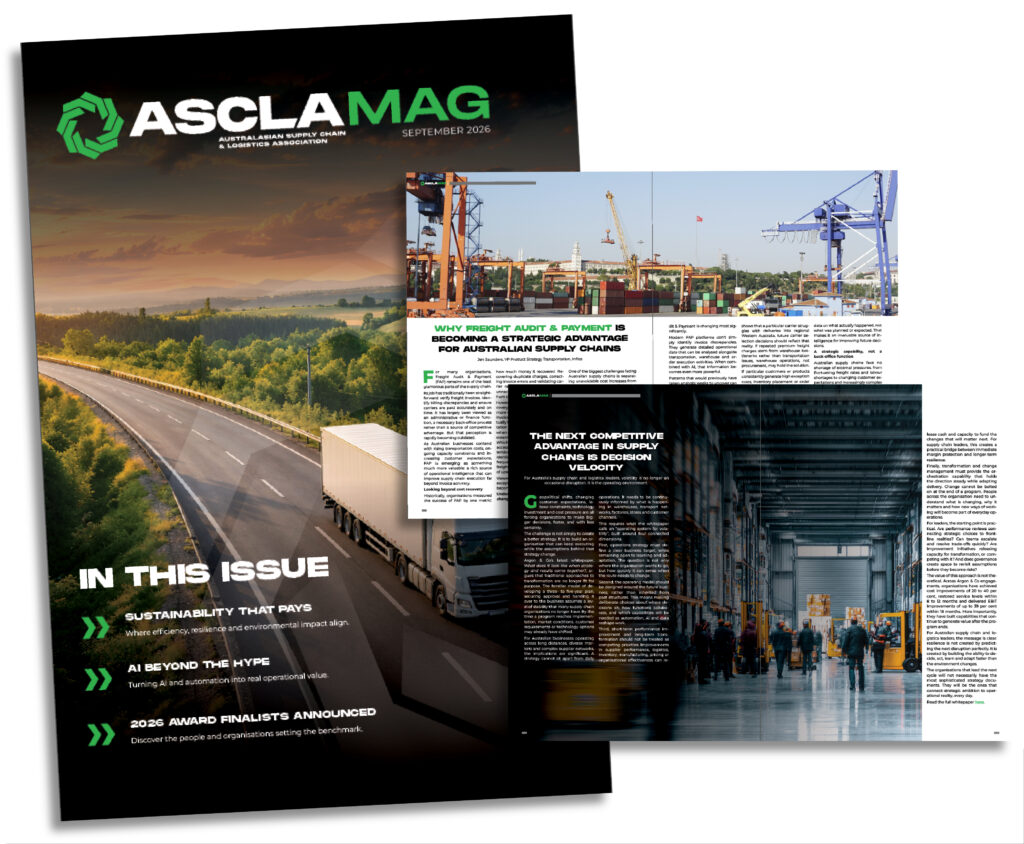
The September 2026 edition of ASCLA Mag explores how sustainability is becoming a practical business advantage across Australasia’s supply chain and logistics industry. As AI, data and operational innovation reshape how goods are planned, moved and delivered, this edition examines the strategies helping organisations reduce waste, improve efficiency, strengthen freight resilience and build the workforce…

Data Centres and the Squeeze on Logistics Land
By Steven Ballerini | CEO of Australasian Supply Chain & Logistics Association (ASCLA) For most of the past decade, the competition for industrial land on the fringes of Sydney and Melbourne was a contest between logistics operators, manufacturers and the developers who built for them. That contest has acquired a new and considerably better-funded participant.…