

Two Hours, Four Thousand Workers — What the FedEx Stoppage Is Really About
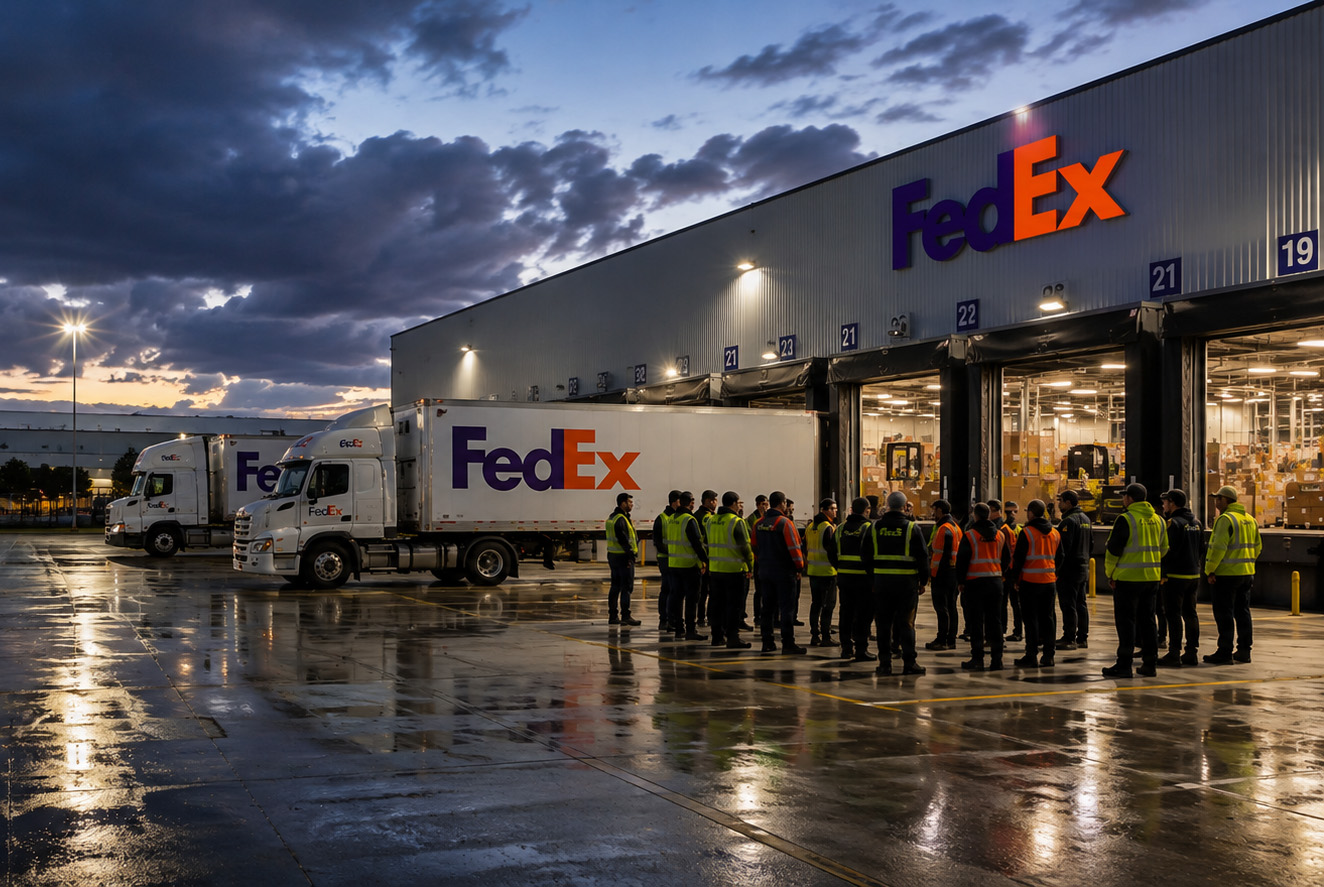
By Steven Ballerini | CEO of Australasian Supply Chain & Logistics Association (ASCLA)
This Friday, close to 4,000 FedEx workers across the country will down tools for two hours. Two hours will not break anybody’s supply chain. A stoppage that short is a signal, not a siege, and if it were only about the hours lost it would not be worth your time reading about. It is worth your time because of the argument underneath it — an argument about who carries the cost of cheap, fast parcel delivery — and that argument does not end when the workers clock back on.It is also an argument with two respectable sides, which is not how it will be reported. So let me set both of them out as fairly as I can, and then say what I think it means for the people who buy this service, because that is most of our membership.
What the Workers Are Asking For
The Transport Workers’ Union ran a protected action ballot the week before last and returned a 91 per cent vote in favour. The claim at the centre of it is not, principally, pay. It is job security: clauses limiting how much work FedEx can push out to contractors, and — newer, and more interesting — provisions covering what happens to jobs as artificial intelligence and automation come into parcel networks. Workers rejected a company offer that, on the union’s account, carried neither.
The union’s case is that the parcel trade already has a working example of where this ends. Contractors, it says, are running piece-rate work with drop quotas as tight as a parcel every four minutes. National Secretary Michael Kaine put it bluntly when hearings opened in July: FedEx, he said, is “taking a leaf out of Amazon’s book to turn decent transport jobs into scraps of low-paid, algorithmically-managed work.” Announcing the stoppage, his tone was more measured: “Workers do not take strike action lightly. They know families and businesses rely on the supplies they move every day,” he said, adding that “the door remains open. FedEx can come back to the table and reach an agreement that gives workers confidence in their future.”
What FedEx Is Saying
FedEx has not run from the conversation. In statements reported this week the company said it “remains committed to working constructively towards an agreement that delivers value,” that its proposed agreement offered competitive employment conditions “while balancing the long-term sustainability” of the business, and — notably — that it supports “minimum standards for contractors across the transport sector,” pointing to its participation in the Fair Work Commission process and industry forums.
That last point deserves more weight than it will get. And the company’s commercial position is not hard to understand either. Parcel volume is the peakiest freight task in the country: the run from Black Friday to Christmas can carry double the volume of a flat week in February. A network sized to peak entirely with permanent labour is a network paying for idle capacity nine months of the year. Outside hire and subcontracting are how every operator in this segment — not just FedEx — has solved that problem for thirty years. Meanwhile the competitive set has changed underneath them: Amazon delivers a growing share of its own freight through a gig-style model, Australia Post carries the universal obligation and the scale that comes with it, and price per parcel has been going backwards in real terms while service promises have gone forwards. Agreeing to hard limits on flexibility while competitors carry none is a real commercial exposure, not a bargaining pose.
Both of those things can be true at once. The workers are right that the model they are pointing at is coming. The company is right that it cannot unilaterally carry a cost its competitors do not.
Why This One Is Not 2021
FedEx workers struck in 2021 and were locked out in the lead-up to Christmas, and that dispute was fought entirely inside one company. This one is not. Since then the Closing Loopholes reforms have given the Fair Work Commission the power to set enforceable minimum standards for regulated road transport workers and to reach up the contractual chain to the businesses that set the rates. A road transport contractual chain order has been in force since April. The TWU’s application for parcel delivery standards began hearings on 22 July, with FedEx in the room.
So the same argument is now running in two places at once — the bargaining table and the Commission — and the second one matters more. If minimum standards land across parcel delivery, the flexibility question changes shape entirely: a cost floor that applies to everyone is a very different proposition to one company agreeing to a floor on its own. That is presumably why FedEx says it supports standards for contractors while resisting the same commitments in its enterprise agreement. It is a coherent position, even if it is a frustrating one for the people voting.
There is a wider timing issue as well. Something in the order of 220 transport agreements are aligned to expire around this year, and in-principle deals have already been struck at Linfox, Team Global Express and BevChain in the range of 10 to 11 per cent over three years. FedEx is not being singled out. It is standing in the middle of a sector-wide bargaining round, and whatever is settled there will be quoted back at the rest of the industry for the next three years.
The Part That Belongs To Us
Here is the uncomfortable part, and I would rather say it to our own members than have somebody else say it about us. Rates in the parcel trade are not set in an enterprise agreement. They are set in tender documents — ours. Every procurement round scored primarily on cents per parcel and a next-day promise pushes cost down the chain until it arrives at the last person who cannot pass it on, which is the driver in the van. If the sector wants secure work and safe drivers, the specifications we write and the prices we accept have to fund them. Chain of responsibility law already says our obligations do not stop at the edge of our own contract, and the new contractual chain provisions extend that logic into commercial terms. Buyers who have never had to think about how their carrier’s subcontractors are paid are about to.
What To Do Between Now and Peak
Practically, for the next few weeks: ask your carriers — all of them, not just FedEx — for their contingency position, and know which of your lanes and sites carry single-carrier exposure. Two hours is nothing; a longer or repeated stoppage in October or November is a different conversation, and pre-peak is exactly when parcel networks have the least slack to absorb one. Talk to your customers early rather than explaining late. Check what your contracts actually say about subcontracting, disclosure and service credits during protected industrial action. And build a little headroom into next year’s freight budget, because whether it arrives through this agreement or through a Commission order, the cost floor in parcel delivery is going up.
The Final Word
Nobody should enjoy this. Two hours off the job is money these workers do not get back, and disruption FedEx does not want in the run to peak. But the dispute is not a morality play, and reporting it as one helps no one. Workers asking for protection against a model they can see arriving are not being unreasonable. A company defending flexibility in the most volume-volatile, price-deflated corner of freight is not being villainous. What is unreasonable is the expectation the rest of us have quietly built the industry on — that parcel delivery can be cheap, fast, and secure all at the same time, forever, and that somebody further down the chain will keep making the numbers work.
Somebody has been. That is the part that is ending, and it is ending in a hearing room as much as on a picket line. Our members should watch this one closely, because whichever way it settles, the price of a parcel is going to tell us something about what kind of industry we have decided to run. As always, that job is ours.
Sources
Transport Workers’ Union, “Thousands of transport workers to strike as FedEx continues to pursue industry low road” (25 August 2026) and “FedEx workers take steps towards strikes as hearings commence for fair parcel delivery standards” (22 July 2026); Australian Financial Review, “FedEx strike to disrupt parcel deliveries when 4000 Transport Workers’ Union members walk off the job” (24 August 2026); Human Resources Director, “FedEx workers to stop work to demand job security protections” (25 August 2026); ChannelNews, “FedEx parcel deliveries face disruption as almost 4,000 workers strike” (August 2026); Mirage News coverage of the July Fair Work Commission hearings; Fair Work Commission, minimum standards order applications MS2024/1–3 and the road transport contractual chain order in force from 21 April 2026; ABC News and SmartCompany coverage of the 2021 FedEx dispute and lockout for historical comparison.
Key figures: protected action ballot returned 91 per cent in favour; close to 4,000 FedEx workers involved; two-hour stoppages announced for Friday of this week; union claims centre on limits to outsourcing and on artificial intelligence and automation provisions, with contractors said to be working to quotas as tight as one parcel every four minutes; FedEx states it supports minimum standards for contractors across the sector and has participated in the Fair Work Commission process; approximately 220 transport enterprise agreements aligned to expire this year, with in-principle agreements at Linfox, Team Global Express and BevChain reported at 10 to 11 per cent over three years. Details accurate as at Wednesday 26 August 2026.
View Similar Blogs

Why Transport Belongs at the Centre of Australia’s Innovation Agenda
By Steven Ballerini | CEO of Australasian Supply Chain & Logistics Association (ASCLA) In August, ASCLA joined 23 other national organisations spanning rail, road, heavy vehicles, freight, logistics, engineering and research in a joint letter to Senator the Hon Tim Ayres, Minister for Industry and Innovation and Minister for Science, asking the Australian Government to…
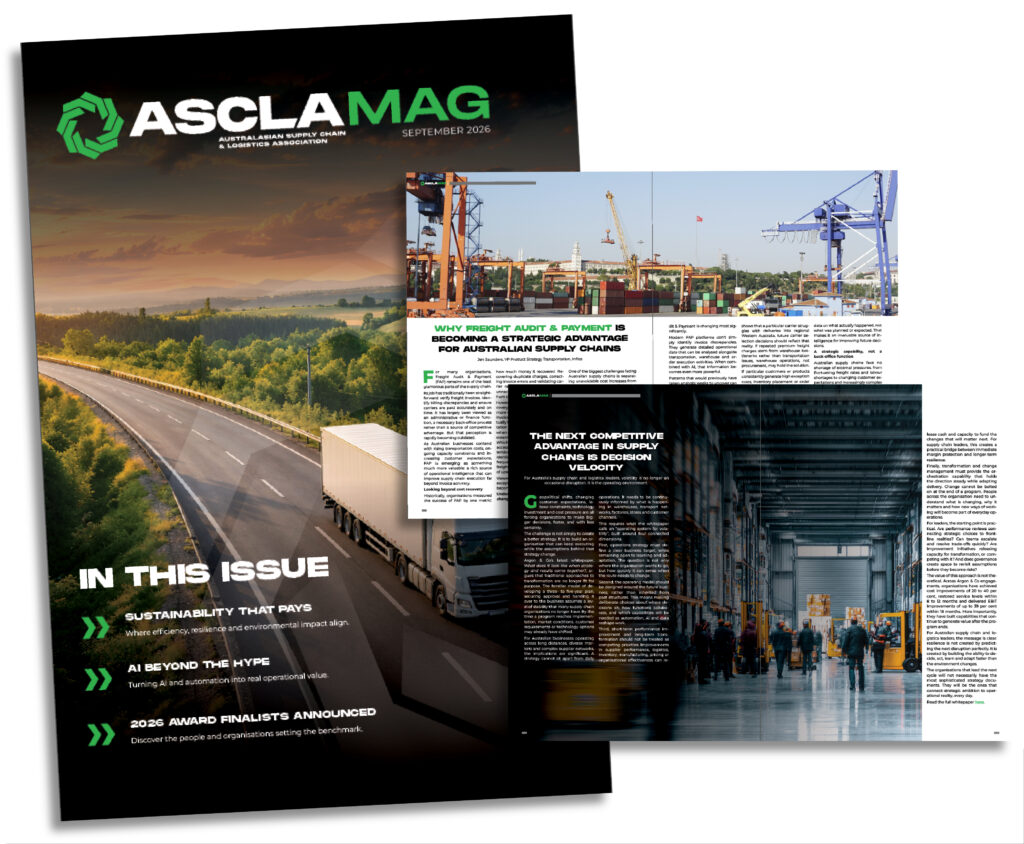
ASCLA Mag September 2026
The September 2026 edition of ASCLA Mag explores how sustainability is becoming a practical business advantage across Australasia’s supply chain and logistics industry. As AI, data and operational innovation reshape how goods are planned, moved and delivered, this edition examines the strategies helping organisations reduce waste, improve efficiency, strengthen freight resilience and build the workforce…

Data Centres and the Squeeze on Logistics Land
By Steven Ballerini | CEO of Australasian Supply Chain & Logistics Association (ASCLA) For most of the past decade, the competition for industrial land on the fringes of Sydney and Melbourne was a contest between logistics operators, manufacturers and the developers who built for them. That contest has acquired a new and considerably better-funded participant.…