

The Amazonification of Logistics: Why Every Supply Chain Leader Should Be Watching This Week

By Steven Ballerini | CEO of Australasian Supply Chain & Logistics Association (ASCLA)
Every now and then a single announcement reframes how an industry thinks about itself. On Monday 4 May 2026, Amazon launched Amazon Supply Chain Services, opening its global logistics infrastructure to any business in the world. Within hours, FedEx shares had fallen 9.1 per cent in their worst trading day in over a year, UPS dropped more than 10 per cent, and contract logistics players including DHL Supply Chain and GXO Logistics took similar hits. The market reaction tells you what the press release alone could not. This is not just another product launch. It is the moment logistics stopped being a service industry and started becoming an infrastructure platform.
What Was Actually Announced
Amazon Supply Chain Services brings the company’s full logistics stack. Freight, distribution, fulfilment and parcel shipping — into a single offering available to any business, regardless of whether they sell on the Amazon marketplace. Initial customers include Procter & Gamble using Amazon’s freight network to move raw materials, 3M using it to transport finished goods to distribution centres, Lands’ End fulfilling cross-channel orders from Amazon warehouses, and American Eagle Outfitters.
The scale of the network being opened up is significant. Amazon’s US logistics footprint includes more than 200 fulfilment centres, over 80,000 trailers, 24,000 intermodal containers, and a fleet of more than 100 cargo aircraft. The company says it delivers 13 billion items annually. In the United States, roughly 28 per cent of all packages shipped now move through Amazon Logistics, putting it second only to USPS by volume and on track to be number one by 2028.
Peter Larsen, the Amazon vice president running the new business and an eighteen-year company veteran, was unambiguous about the playbook. He compared the launch directly to the origins of Amazon Web Services, telling reporters that Amazon is bringing its supply chain to outside businesses much like AWS did for cloud computing. That comparison is the strategic key to understanding what just happened.
Why the AWS Analogy Is the Whole Story
Twenty years ago, AWS started life as Amazon’s internal cloud infrastructure. The company built it because it had to, then realised the real prize was selling that capability to everyone else. AWS now generates over USD 110 billion in annual revenue and is the operating profit engine of the entire Amazon group. The same pattern is now being applied to physical logistics.
Parth Talsania, CEO of Equisights Research, captured the shift in one line: Amazon is trying to convert logistics from a cost burden into an infrastructure product. That framing matters because it changes who Amazon is competing against. UPS and FedEx are now competing not with another carrier but with a platform business backed by 181.5 billion US dollars of quarterly revenue and a willingness to operate logistics at the kind of margins that would terrify a traditional carrier.
Bloomberg analysis suggests the move is most threatening in business-to-business shipping, the high-margin segment where deliveries are denser, more predictable and cheaper to serve than consumer parcels. That is precisely where incumbent carriers make their money. The Bloomberg call describes the announcement as a structural warning shot, particularly in e-commerce-heavy lanes where Amazon already has density, data and a delivery-speed advantage.
This Is Not An Isolated Story
The Amazon launch is the loudest signal of a much broader trend. The same week, Mediterranean Shipping Company’s Australian arm Medlog Oceania completed its acquisition of the Ettamogah Rail Hub near Albury-Wodonga, one of the most strategically important intermodal facilities in New South Wales. MSC, already the world’s largest container shipping line by capacity at 7.29 million TEU and 21.6 per cent of global capacity, is now reaching directly into Australian inland freight.
The pattern is consistent. Shipping lines are buying inland terminals. Retailers are buying carriers. Tech platforms are building airlines. Penske Logistics has just launched a real-time supply chain visibility platform that consolidates transportation and warehouse data into a single dashboard. NVIDIA’s cuOpt Agent Skills is offering AI-driven optimisation for supply chain decisions at a level previously available only to the largest enterprises. Manhattan Associates has rolled out autonomous AI agents that compress thirty to forty-five minutes of warehouse supervisor work into seconds. Each of these moves chips away at the assumption that has underwritten the third-party logistics industry for forty years: that operating logistics is hard, specialised work that most businesses should outsource to specialists.
What if it isn’t, anymore? What if logistics becomes something a business consumes through an API, the way it consumes compute, storage and payments today?
What This Means for Australian Supply Chains
Australia is not the United States and Amazon’s domestic logistics build-out here is a fraction of its US scale. But the strategic implications travel. Three observations are worth making.
First, the competitive moat for traditional 3PLs in Australia is narrower than many operators assume. Linfox, Toll, DHL Australia and the major contract logistics players have built defensible businesses on operating expertise, network density and customer relationships. None of those advantages are immune to a platform competitor with global scale and a willingness to price aggressively for share. The 9 to 13 per cent share-price drops experienced by global incumbents this week are a preview of the conversation Australian boards will eventually need to have.
Second, the same logic Amazon is applying to logistics could be applied locally by the businesses that already operate at scale. Coles and Woolworths run two of the most sophisticated supply chains in the country. Australia Post operates the largest delivery network. Wesfarmers has Bunnings, Kmart, Officeworks and Catch all running through related infrastructure. Any one of these businesses could plausibly decide that opening its supply chain to third parties is a higher-margin business than the retail it currently supports. The question is whether they get there before someone else builds the platform around them.
Third, the supply chain professional’s career arc is changing. The skills that mattered in 2010 were operational. The skills that will matter in 2030 are a combination of operational depth and platform fluency: the ability to integrate, configure, orchestrate and design across third-party logistics infrastructure rather than build everything in-house. ASCLA’s mentoring programme and capability work over the next two years should reflect that shift directly.
The Cost Pressure Backdrop
These structural changes are landing on top of an already volatile cost environment. Continued disruption in the Strait of Hormuz this week saw US forces seize an Iran-flagged containership and Iranian forces fire on another vessel. Bunker price volatility prompted carriers to recalculate fuel surcharges more frequently, with some shippers moving from quarterly to monthly adjustment cycles. Intra-Asia container freight rates rose by an average of 10 per cent over the past fortnight as bunker increases flowed through to short-haul trades.
For Australian importers, that means landed cost is moving every fortnight rather than every quarter. For exporters, it means freight cost is now a strategic variable rather than a budget line. Combine that with the structural pressure Amazon’s announcement just put on incumbent carriers, and the operating environment for the next eighteen months looks more like the early pandemic than anything resembling normality. Supply chain leaders who were hoping for a return to predictable freight markets in 2026 should adjust their planning accordingly.
What Supply Chain Leaders Should Be Doing Now
This is not the kind of story to read once and move past. ASCLA encourages members to take three practical steps over the coming weeks.
First, get serious about scenario modelling. If a platform competitor entered your category at half the price point and double the technology investment, what would your business look like? Most Australian supply chain operators have not stress-tested their model against a platform challenger. The companies that did this exercise twelve months before AWS hit their industry came through it well. The ones that did not are mostly gone.
Second, audit your platform readiness. If Amazon Supply Chain Services or an equivalent reached the Australian market in three years, could your business plug into it as a customer, a complement or a partner? The businesses that benefit most from platform shifts are usually not the platform itself, but the businesses that move quickly to position themselves around it.
Third, take the technology conversation out of the IT department. The integration of AI agents, control towers and visibility platforms is no longer a digital project. It is a strategic question about what your business is fundamentally for. Boards and executive teams that delegate that conversation downward will find it has been answered by competitors before they get to it.
The Final Word
Amazon Supply Chain Services will not destroy the global logistics industry. UPS, FedEx, DHL, Maersk, MSC and the major Australian 3PLs are not about to disappear. But the assumption that has underwritten the industry for forty years — that logistics is something specialists do for everyone else — is now under direct challenge from a competitor that thinks of logistics the way it thinks of cloud computing. The companies that recognise this for what it is, and adjust their strategy accordingly, will be the ones that emerge stronger from the next decade.
The week of 4 May 2026 will be remembered as the week the logistics industry started becoming an infrastructure industry. Australian supply chain leaders should be paying close attention. The trend is not coming. It is here.
References
Amazon turns its logistics empire into a new business — GeekWire (4 May 2026) — https://www.geekwire.com/2026/amazon-turns-its-logistics-empire-into-a-new-business-taking-on-ups-and-fedex-in-freight-and-shipping/
UPS, FedEx stocks sink after Amazon expands logistics network — CNBC (4 May 2026) — https://www.cnbc.com/2026/05/04/ups-fedex-amazon-logistics.html
FedEx, UPS Shares Drop as Amazon Expands Logistics Services — Bloomberg (4 May 2026) — https://www.bloomberg.com/news/articles/2026-05-04/fedex-ups-shares-tumble-on-amazon-s-watershed-logistics-move
Amazon Opens up Logistics Network to Other Businesses in Challenge to UPS, FedEx — Reuters via U.S. News (4 May 2026) — https://money.usnews.com/investing/news/articles/2026-05-04/amazon-opens-up-its-logistics-network-to-other-businesses
Amazon opens logistics network to all businesses — Supply Chain Dive (5 May 2026) — https://www.supplychaindive.com/news/amazon-opens-logistics-network-to-all-businesses/819178/
Amazon Supply Chain Services — Amazon (corporate site) — https://supplychain.amazon.com/
Amazon takes aim at the supply chain — Axios (5 May 2026) — https://www.axios.com/2026/05/05/amazon-logistics-ups-fedex
Australia’s Strategic Acquisition of Ettamogah Rail Hub — Travel and Tour World (May 2026) — https://www.travelandtourworld.com/news/article/australias-strategic-acquisition-of-ettamogah-rail-hub-signals-a-new-era-for-freight-logistics/
Fracht Australia Logistics News — May 2026 (MSC fleet milestone, Strait of Hormuz, intra-Asia rates) — https://fracht.com.au/news/fracht-australia-logistics-news-may-2026/244
2026 Countdown: Is Australia’s Transport Industry Future-Ready? — Supply Chain Insights — https://www.supplychain-insights.media/insights/2026-countdown-is-australias-transport-industry-future-ready
Amazon Logistics Statistics 2026 — Capital One Shopping Research — https://capitaloneshopping.com/research/amazon-logistics-statistics/
View Similar Blogs
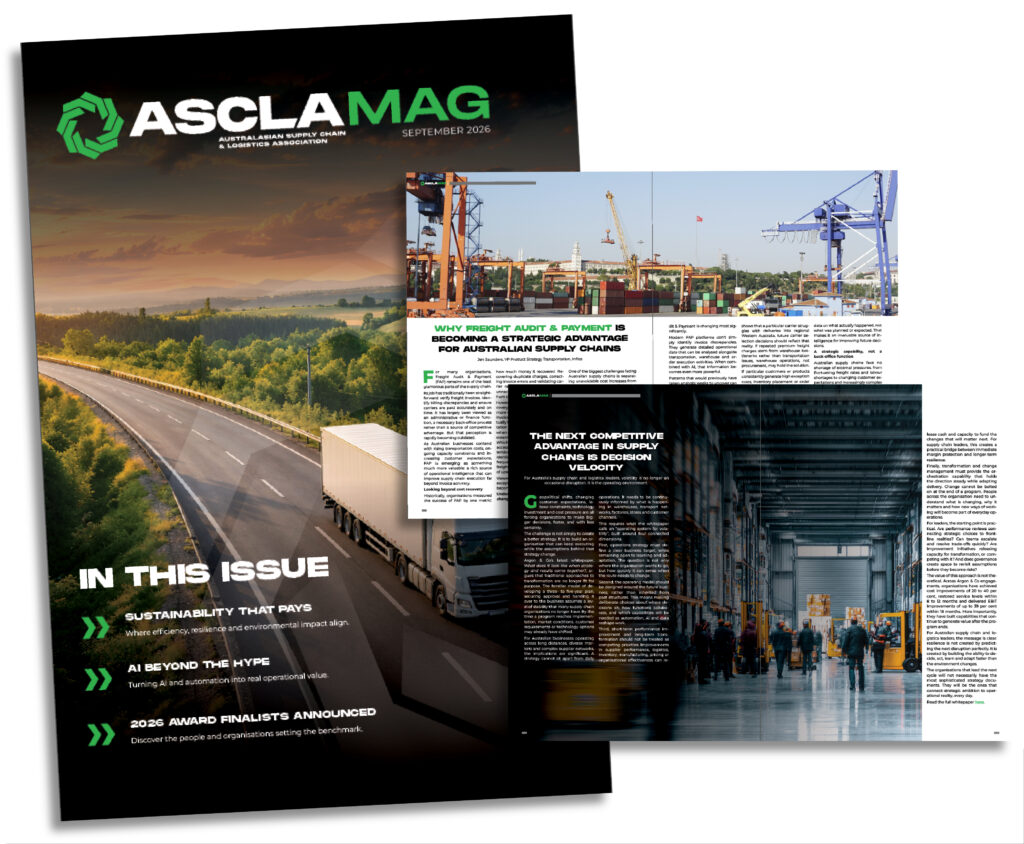
ASCLA Mag September 2026
The September 2026 edition of ASCLA Mag explores how sustainability is becoming a practical business advantage across Australasia’s supply chain and logistics industry. As AI, data and operational innovation reshape how goods are planned, moved and delivered, this edition examines the strategies helping organisations reduce waste, improve efficiency, strengthen freight resilience and build the workforce…

Data Centres and the Squeeze on Logistics Land
By Steven Ballerini | CEO of Australasian Supply Chain & Logistics Association (ASCLA) For most of the past decade, the competition for industrial land on the fringes of Sydney and Melbourne was a contest between logistics operators, manufacturers and the developers who built for them. That contest has acquired a new and considerably better-funded participant.…
Celebrating an Industry That Rarely Celebrates Itself
By Steven Ballerini | CEO of Australasian Supply Chain & Logistics Association (ASCLA) On Friday 23 October the industry will gather at Brisbane City Hall for the ASCLA Industry Awards, and for the first time in more than six decades of the awards the night will be held in Brisbane. Six decades is a long…