

$6.15 Billion Reasons to Rethink Supply Chain Resilience

By Steven Ballerini | CEO of Australasian Supply Chain & Logistics Association (ASCLA)
Australia’s supply chains have been under sustained pressure for the better part of three years. Fuel price volatility, geopolitical shocks, freight bottlenecks, and the lingering structural weaknesses exposed by the pandemic have made resilience the defining challenge of this decade for logistics and supply chain professionals. Earlier this April 2026, the federal government put a significant number on its response. $6.15 billion in concessional capital, brought forward from the National Reconstruction Fund, will be made available to Australian businesses now rather than later. For supply chain executives, this is worth understanding in detail.
What Is Actually Being Announced
The $6.15 billion is not new money. It is an acceleration of funding already committed under the federal government’s $15 billion National Reconstruction Fund, moved forward from its original mid-year timeline to get capital flowing to businesses under pressure now. It comprises three distinct programs.
- The Economic Resilience Program is the most immediately relevant for supply chain operators. A $1 billion pool of zero-interest loans targeted at fuel, fertiliser, and other critical supply chain businesses; it is designed to support domestic industries directly hit by market disruption. The intent is blunt: keep trucks, trains, and planes moving when global conditions make that difficult.
- The Net Zero Fund, at $5 billion, is the largest component and takes a longer view. Originally scheduled to open mid-year, it has been brought forward to support new manufacturing investment and improve energy efficiency in sectors that are difficult to decarbonise. This includes building domestic capability in clean energy supply chains covering wind, solar, and energy storage, as well as supporting the production of low-carbon liquid fuels.
- The Forestry Growth Fund rounds out the package with $150 million directed at timber processing, mill investment, and increasing the value of forestry products feeding into housing construction supply chains.
Why Now, and Why It Matters
The timing is deliberate. Global supply chains have been operating under sustained pressure, and the Iran conflict is the latest in a sequence of geopolitical shocks that have exposed just how vulnerable Australian businesses are to disruption they cannot control. Fuel price volatility, fertiliser supply constraints, and logistics bottlenecks have compounded one another, and the government’s response reflects a growing recognition that waiting for markets to self-correct is not a strategy.
For supply chain executives, the framing of this announcement matters as much as the dollars. This is not a COVID-era emergency stimulus package. It is concessional capital – structured finance designed to be invested rather than consumed. The message to industry is clear: use this period of disruption as a catalyst to build capability, not simply to survive it.
What It Means for Supply Chain Leaders
The most immediate opportunity sits within the Economic Resilience Program. Zero-interest loans for businesses operating in fuel, fertiliser, and critical logistics represent genuine working capital relief for operators whose margins have been compressed by input cost volatility. If your business sits anywhere in those supply chains (and most do, directly or indirectly), it is worth understanding the eligibility criteria before the program opens.
Beyond the immediate, the Net Zero Fund signals where government investment priorities are heading. Supply chain leaders who have been deferring decarbonisation decisions due to cost or uncertainty now have a cleaner pathway to funding. The emphasis on low-carbon liquid fuels is worth noting in particular for road and air freight operators watching the energy transition with concern about stranded assets and transition timelines.
There is also a strategic signal here that goes beyond the individual programs. Australia is moving, however incrementally, toward a deliberate industrial policy – one that treats supply chain resilience as a national priority rather than a business problem. That shift has real implications for how supply chain executives engage with government, how they make long-term investment decisions, and how they position their businesses in conversations about sovereign capability.
The Broader Context
This announcement does not exist in isolation. It follows sustained industry advocacy around supply chain vulnerability, much of it driven by the exposure of critical gaps during the pandemic and amplified by every subsequent disruption. The fact that the government has accelerated funding rather than simply restated commitments suggests that advocacy is landing. For industry associations and supply chain leaders, that is an important signal about what continued engagement can achieve.
It also comes at a moment when supply chain as a discipline is increasingly visible at the boardroom and cabinet table. The executives who move quickly to understand these programs and position their businesses to access them will have a material advantage over those who wait for the dust to settle.
What Supply Chain Leaders Should Be Doing Now
This is not the moment to file the announcement away and move on. ASCLA encourages all members to take three practical steps in the near term.
First, understand the programs. The Economic Resilience Program and the Net Zero Fund are both opening shortly. Eligibility criteria, application processes and timelines will be confirmed by the National Reconstruction Fund. Subscribe to NRF updates at nrf.gov.au so you are not catching up when the windows open.
Second, audit your exposure. If your business is in fuel, fertiliser, logistics, or manufacturing, assess where you are carrying cost volatility that government concessional finance could help address. Zero-interest capital is a genuine commercial tool, not a grant program for distressed businesses. Profitable businesses with genuine investment cases should be looking at this.
Third, think structurally. The Net Zero Fund, in particular, rewards businesses that come with a credible investment plan rather than a reactive one. If you have been watching the energy transition from the sidelines, now is the time to get serious about what decarbonisation looks like for your operations and what it costs.
The Final Word
The $6.15 billion is not a solution to Australia’s supply chain challenges. It is, however, a meaningful commitment that the challenges are real, that they require a structural response, and that government is willing to put capital behind that view. The executives who treat this as a wake-up call rather than a news item will be better placed for what comes next.
Australia imports around 90 per cent of its liquid fuels and a significant proportion of its critical manufactured inputs. Supply chain resilience is not an aspiration – it is a competitive necessity. The businesses that come through this decade in good shape will not be those that managed disruption most efficiently. They will be those who use moments like this one to build something more durable.
Reference Links
$6.15 billion brought forward to support business – Prime Minister of Australia
$6.15 billion brought forward to support business – Department of Industry, Science and Resources
View Similar Blogs
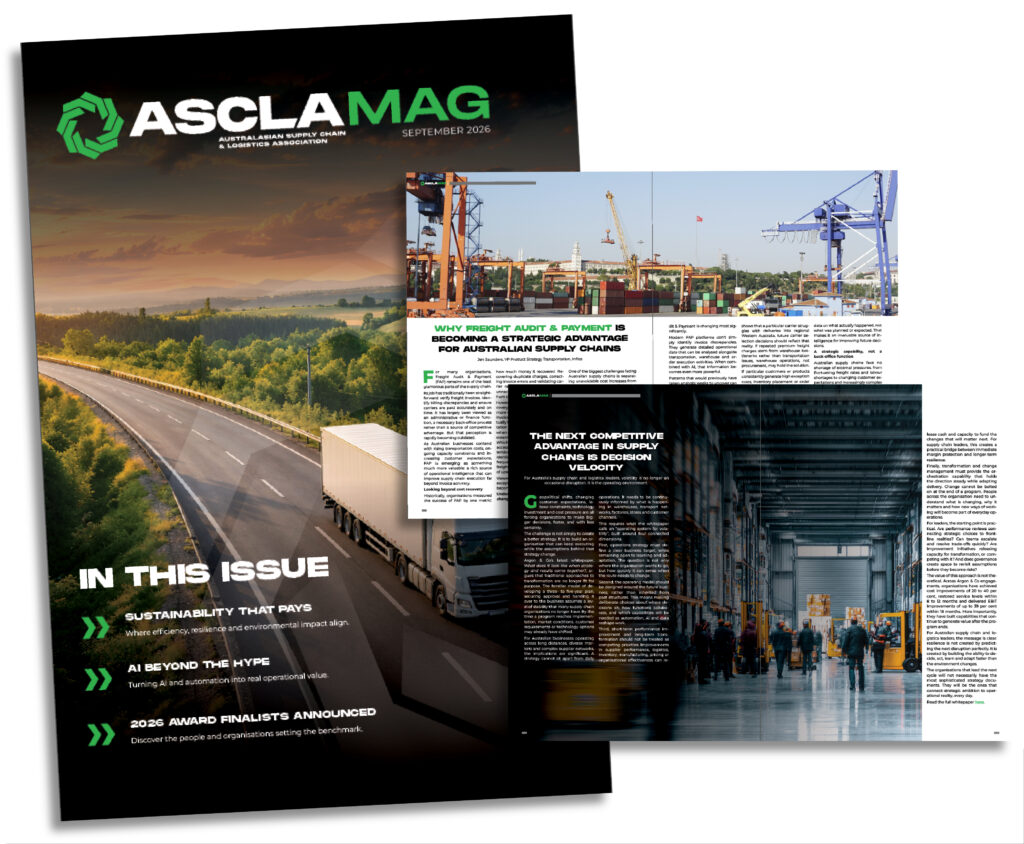
ASCLA Mag September 2026
The September 2026 edition of ASCLA Mag explores how sustainability is becoming a practical business advantage across Australasia’s supply chain and logistics industry. As AI, data and operational innovation reshape how goods are planned, moved and delivered, this edition examines the strategies helping organisations reduce waste, improve efficiency, strengthen freight resilience and build the workforce…

Data Centres and the Squeeze on Logistics Land
By Steven Ballerini | CEO of Australasian Supply Chain & Logistics Association (ASCLA) For most of the past decade, the competition for industrial land on the fringes of Sydney and Melbourne was a contest between logistics operators, manufacturers and the developers who built for them. That contest has acquired a new and considerably better-funded participant.…
Celebrating an Industry That Rarely Celebrates Itself
By Steven Ballerini | CEO of Australasian Supply Chain & Logistics Association (ASCLA) On Friday 23 October the industry will gather at Brisbane City Hall for the ASCLA Industry Awards, and for the first time in more than six decades of the awards the night will be held in Brisbane. Six decades is a long…