

NSW Opens the Door to Serious Fuel Security Investment

By Steven Ballerini | CEO of Australasian Supply Chain & Logistics Association (ASCLA)
The NSW Government has signalled a significant shift in how it intends to address one of the most quietly persistent risks sitting underneath the Australian supply chain: the country’s heavy dependence on imported liquid fuels and the long, exposed sea lanes that bring them here. On 17 May 2026, Treasurer Daniel Mookhey, Planning Minister Paul Scully and Industry and Trade Minister Anoulack Chanthivong announced that the Investment Delivery Authority (IDA) will run a targeted Expression of Interest round calling for major projects that strengthen the state’s fuel resilience.
For an industry that moves the vast majority of Australia’s domestic freight on diesel, and which has watched Middle East instability ripple through bunker prices, insurance settings and shipping schedules over the past two years, this is a development worth paying close attention to.
What Has Been Announced
The targeted IDA round is open to commercial-scale projects valued at $100 million or more that directly improve fuel security. Three categories of project are in scope: fuel storage and distribution infrastructure; domestic, import-independent liquid fuel production focused on renewable fuels and their feedstocks (sustainable aviation fuel, renewable diesel, biodiesel, biomethane and green ammonia); and heavy electric vehicle charging hubs and fleets designed to reduce reliance on diesel over time.
The round opens on 1 June 2026 and proponents will have three weeks to submit. The IDA will use its existing operating model to remove delivery barriers, coordinate engagement across government agencies, and accelerate endorsed projects through approvals.
Recognising that not every promising project is shovel-ready, the NSW Government is also running a parallel Market Sounding process. This gives proponents at an earlier stage of development a way to put forward information about potential projects without needing to meet the full EOI threshold. It is a sensible piece of design that should capture a wider pool of capability than a hard $100 million cut-off would otherwise allow.
In a related move, the Renewable Fuel Scheme will be expanded to include low-carbon and renewable liquid fuels alongside the green hydrogen and biomethane incentives already in place. Industry will be consulted on the changes, which are explicitly aimed at giving investors the confidence to commit capital and to unlock private and Commonwealth co-investment.
Why This Matters for Supply Chain and Logistics
Fuel security has long been treated as an energy portfolio issue. In practice, it is a supply chain issue. Australia holds relatively thin domestic stocks of refined liquid fuels by international standards, and the country’s remaining refining capacity sits well below historical levels. For freight operators, this exposure shows up as price volatility, contract risk, and in extreme scenarios, the genuine prospect of disruption to fleet operations and the goods movement that depends on them.
The categories that the IDA is targeting map directly onto the practical challenges that supply chain operators are working through.
Storage and distribution infrastructure addresses the buffer problem. Greater domestic storage capacity gives shippers, fleet operators and government agencies more room to absorb a price spike or a supply interruption without it flowing immediately through to freight rates and shelf prices.
Renewable liquid fuels are arguably the most consequential category for heavy freight. Battery electrification will not realistically reach line haul, regional distribution or aviation within the timeframes that operators and their customers are now working to. Sustainable aviation fuel, renewable diesel and biodiesel are drop-in or near-drop-in solutions that can use existing fleets and existing distribution networks. A domestic production base for these fuels would meaningfully reduce the import dependency that currently defines Australia’s fuel position.
Heavy EV charging hubs and fleets address the segments where electrification does make commercial and operational sense, particularly metropolitan distribution, port shuttles and short-haul operations. The hub-and-fleet framing is important. Charging infrastructure without the fleet to use it is stranded capital; fleet investment without the charging network is stranded operationally. Coordinated investment in both is what unlocks the transition.
What Proponents Should Be Thinking About
For ASCLA members considering whether to engage with this round, a few practical observations.
First, the $100 million threshold is a serious one but the Market Sounding process provides a genuine alternative pathway for earlier-stage proposals. Operators with credible projects that are not yet ready for full EOI submission should still consider participating, both to put their thinking on the record and to gauge government appetite.
Second, the IDA’s value proposition is delivery, not money. Its role is to help projects cut through complexity, coordinate across agencies, and progress through planning, environmental and regulatory frameworks more efficiently. Proponents should come prepared with a clear view of which approval pathways and which agencies are most likely to slow their project down, and how IDA support could shift those timelines.
Third, the strongest submissions are likely to be those that link directly to identified resilience benefits: how much storage, how much production capacity, how many vehicles, how much diesel displaced, how many regional jobs. Generic claims will be less compelling than measurable contributions to the state’s fuel position.
Finally, the parallel expansion of the Renewable Fuel Scheme creates a useful policy and incentive backdrop. Projects that can credibly stack IDA delivery support, Renewable Fuel Scheme incentives and Commonwealth co-investment will be in a stronger position than those relying on a single instrument.
The Final Word
Strengthening fuel security is fundamentally a supply chain question dressed up as an energy one. The NSW Government’s decision to channel this work through the IDA, with a clear $100 million scale threshold, a defined three-week window and a parallel Market Sounding option, is a constructive signal to industry. It tells proponents that the state is prepared to work with serious projects, and it sets a model that other jurisdictions may well follow.
For members operating in storage, distribution, fleet, fuel production or charging infrastructure, the next three weeks from 1 June are worth diarising. The round will not be reopened lightly, and the projects that come through this window will shape the resilience of the state’s fuel supply for the decade ahead.
References
Strengthening NSW fuel security through the Investment Delivery Authority — Media Release, NSW Government (17 May 2026)
Investment Delivery Authority — Investment NSW
https://www.nsw.gov.au/departments-and-agencies/investment-nsw/investment-delivery-authority
Renewable Fuel Scheme — NSW Government
View Similar Blogs
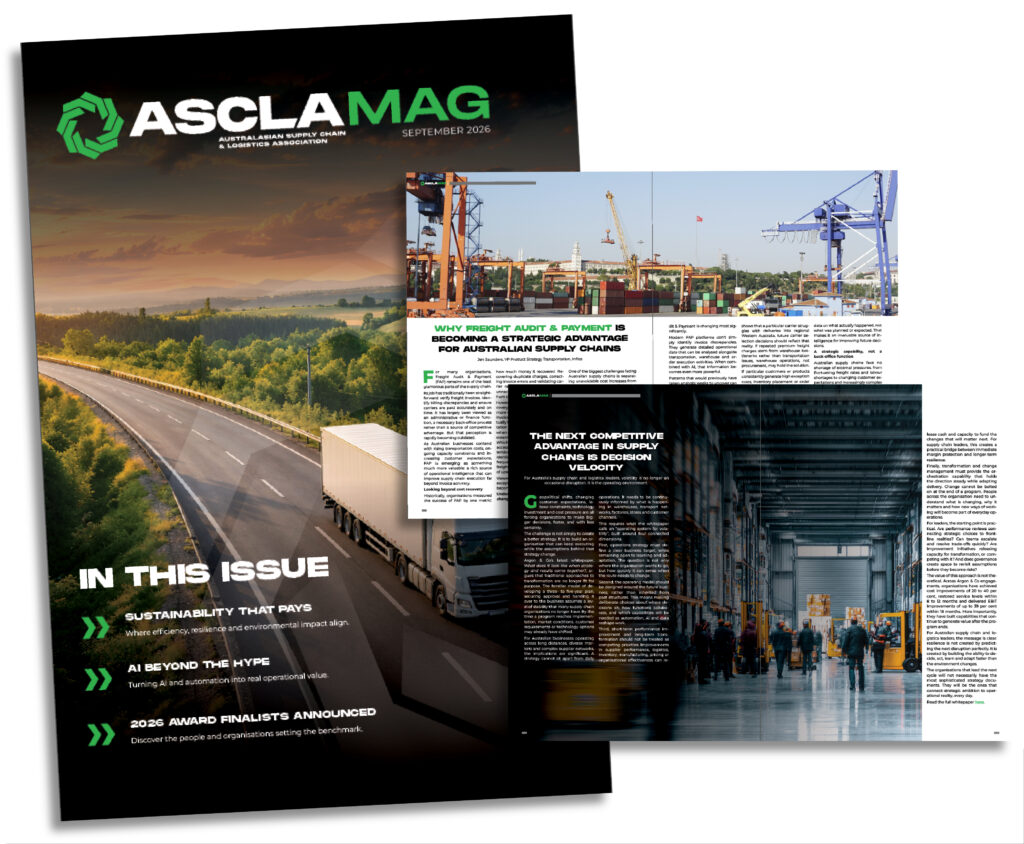
ASCLA Mag September 2026
The September 2026 edition of ASCLA Mag explores how sustainability is becoming a practical business advantage across Australasia’s supply chain and logistics industry. As AI, data and operational innovation reshape how goods are planned, moved and delivered, this edition examines the strategies helping organisations reduce waste, improve efficiency, strengthen freight resilience and build the workforce…

Data Centres and the Squeeze on Logistics Land
By Steven Ballerini | CEO of Australasian Supply Chain & Logistics Association (ASCLA) For most of the past decade, the competition for industrial land on the fringes of Sydney and Melbourne was a contest between logistics operators, manufacturers and the developers who built for them. That contest has acquired a new and considerably better-funded participant.…
Celebrating an Industry That Rarely Celebrates Itself
By Steven Ballerini | CEO of Australasian Supply Chain & Logistics Association (ASCLA) On Friday 23 October the industry will gather at Brisbane City Hall for the ASCLA Industry Awards, and for the first time in more than six decades of the awards the night will be held in Brisbane. Six decades is a long…