

Smaller Baskets, Bigger Task — Inside the $21.9 Billion eCommerce Quarter
By Steven Ballerini | CEO of Australasian Supply Chain & Logistics Association (ASCLA)
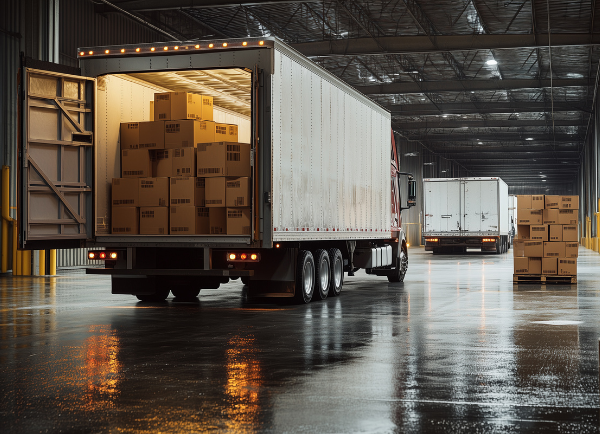
Another quarter, another record. Australians spent $21.9 billion online in the final three months of the financial year, up 14 per cent on the same period a year ago, and the coverage has dutifully reported the growth. For most readers that is where the story ends. For those of us who move the freight, it is where it starts.
The headline is real, and worth pausing on. But underneath it sits a shift in how Australians are buying that has more to say about our sector than the total ever could. The dollars are up. The way they arrive at the doorstep is changing — and changing in a direction that asks more of the network, not less.
What’s Driving the Growth
Two forces are doing most of the work. The first is the calendar. End of Financial Year sales pulled spending forward and concentrated it, part of a broader pattern in which shoppers increasingly wait for the discount before they buy. Australia Post’s research puts hard numbers on it: nearly six in ten say they never pay full price anymore, and 58 per cent say they enjoy the build-up to a major sale. Australia Post calls the mood the “Lipstick Effect” — trimming the big discretionary buys while still treating themselves to smaller, affordable ones.
The second force is the marketplace. Of that $21.9 billion, $5.1 billion flowed through online marketplaces, which now handle 42 per cent of all online purchases — the likes of Amazon, Temu and Shein, competing hardest on price and breadth exactly when shoppers are most value-driven. As Australia Post’s Chelsea O’Reilly put it, “Australian consumers aren’t spending less, but they’re becoming more deliberate with every dollar.” Millennials led the generations at $7.8 billion, but the fastest growth came from the Builders — the oldest cohort — up 18 per cent.
The Catch: Smaller Baskets, More Parcels
Here is the number our sector should circle. As spend rose, the average online basket fell to a record low of $90, down from $96 a year ago. Read those two figures together and the picture sharpens: more money is moving online, but it is arriving in smaller, more frequent orders. Value up and basket down means parcels up — faster than the dollars.
That is the pressure point. A delivery network is paid, roughly, per parcel, but its cost sits in the handling: the pick, the sort, the last-mile stop. Smaller baskets mean more of all three for every dollar of retail value, and marketplace freight — high in volume, low in value — pushes the same way. The task facing operators is growing faster than the revenue attached to it, and it is bunching around sale peaks rather than spreading evenly across the year. More parcels, worth less each, delivered in spikes. That is a harder network to run than a 14 per cent headline suggests.
A Network Being Rebuilt to Cope
The good news is that the capital is following the volume. Australia Post has just broken ground on a $500 million Parcel Super Hub at the former Holden site in Adelaide — its largest-ever investment in South Australia — an 83,000-square-metre, heavily automated facility built to process up to 400,000 parcels a day when it opens in 2028. It will not be the last of its kind.
Nor is Australia Post the only one moving. The Australian Financial Review reported this week that Allegro Funds and Christine Holgate are riding a Temu-driven parcel boom to a $100 million capital raising at Team Global Express, as the private network positions to challenge Australia Post in parcels — particularly in the regional last-mile, where the growth is strongest. Out-of-home options are scaling too: Parcel Locker and collection-point deliveries are growing at around 17 per cent a year, with real headroom left, since more than four in ten shoppers still do not know the lockers exist. The common thread is that delivery has stopped being the back end of the sale. Australia Post’s data shows 73 per cent of shoppers are more likely to buy online when the delivery experience is good — the doorstep is now part of the conversion.
The Final Word
So yes, celebrate the $21.9 billion — it is a genuinely strong quarter in a soft economy. But for our members the number is a prompt, not a trophy. The growth is a volume story, not a value one: more parcels, smaller and more frequent, chasing sale peaks and riding a marketplace surge. The businesses that plan for the parcel rather than the dollar — that build for peak, invest in last-mile and out-of-home capacity, and treat cost-to-serve as the metric that matters — will be the ones still standing when the next EOFY, and the next Black Friday, lands. The country sees a record. We see the job behind it. As always, that job is ours.
Sources
Australia Post, Quarterly eCommerce Report, Q4 FY26, via MHD Supply Chain (“E-commerce spend reaches $21.9 billion as shoppers chase value,” 4 August 2026) and Inside Retail / retailbiz, July–August 2026 ($21.9 billion online spend, up 14 per cent year-on-year; 9.3 million households; online marketplaces $5.1 billion and 42 per cent of online purchases; food and liquor $4.4 billion, fashion $3.1 billion; average basket size a record-low $90; “Lipstick Effect”; nearly six in ten never buy at full price and 58 per cent enjoy the sale build-up; Millennials $7.8 billion, Gen X $6 billion, Gen Z $3.8 billion; Builders fastest at +18 per cent; Chelsea O’Reilly, General Manager Parcel, Post and eCommerce Services, Australia Post); Australia Post, eCommerce Report 2026, March 2026 ($82.6 billion online in 2025, up 14 per cent, 24 per cent of retail; 9.8 million households; average of 16 retailers per household; marketplaces $18.9 billion; 73 per cent more likely to shop online with a good delivery experience; out-of-home deliveries growing around 17 per cent year-on-year; more than four in ten shoppers unaware of Parcel Lockers); Australia Post, “Works start on our Adelaide Parcel Super Hub,” and MHD / Prime Mover Magazine, late July 2026 ($500 million Adelaide Parcel Super Hub; former Holden site, Elizabeth; 83,000 square metres; up to 400,000 parcels a day; first integrated Australia Post and StarTrack facility; opening 2028); Australian Financial Review, “Allegro and Christine Holgate ride a Temu boom to $100m capital raising,” 30 July 2026, with context from ChannelNews on the Team Global Express–Temu partnership (private-network capital raising; positioning against Australia Post in parcels and regional last-mile).
View Similar Blogs
ASCLA Mag September 2026
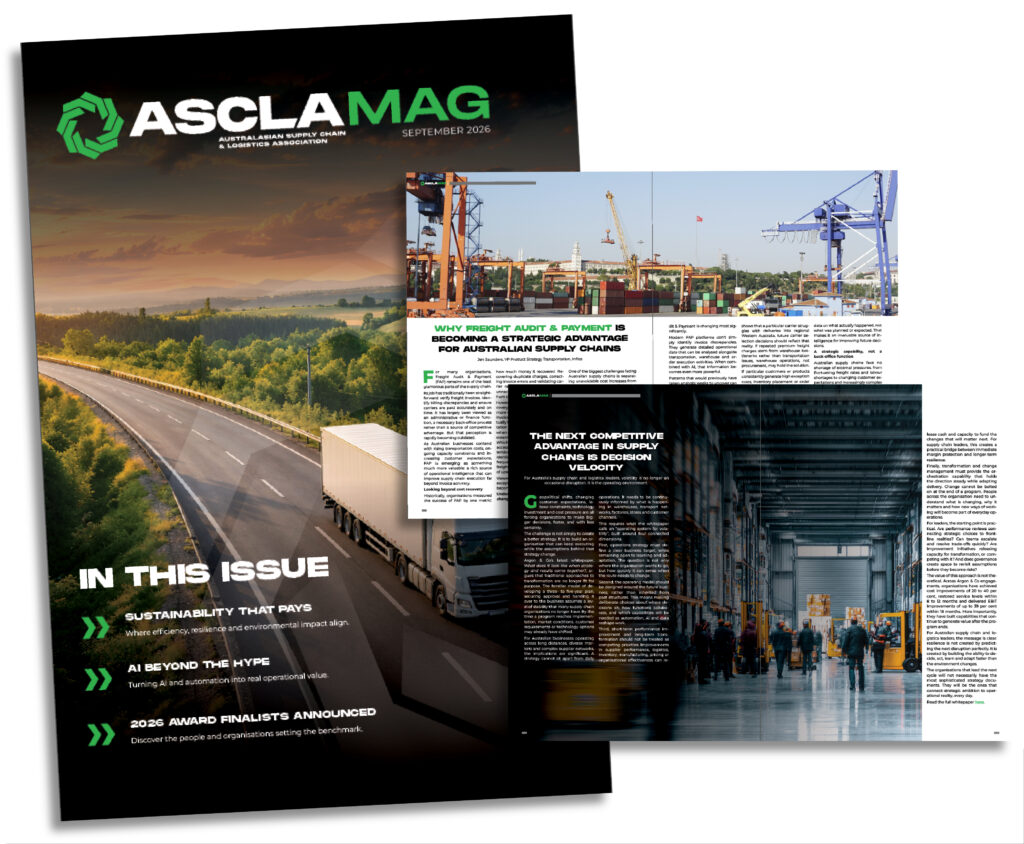
The September 2026 edition of ASCLA Mag explores how sustainability is becoming a practical business advantage across Australasia’s supply chain and logistics industry. As AI, data and operational innovation reshape how goods are planned, moved and delivered, this edition examines the strategies helping organisations reduce waste, improve efficiency, strengthen freight resilience and build the workforce…

Data Centres and the Squeeze on Logistics Land
By Steven Ballerini | CEO of Australasian Supply Chain & Logistics Association (ASCLA) For most of the past decade, the competition for industrial land on the fringes of Sydney and Melbourne was a contest between logistics operators, manufacturers and the developers who built for them. That contest has acquired a new and considerably better-funded participant.…
Celebrating an Industry That Rarely Celebrates Itself
By Steven Ballerini | CEO of Australasian Supply Chain & Logistics Association (ASCLA) On Friday 23 October the industry will gather at Brisbane City Hall for the ASCLA Industry Awards, and for the first time in more than six decades of the awards the night will be held in Brisbane. Six decades is a long…