

What the Federal Budget Means for Australian Supply Chains

By Steven Ballerini | CEO of Australasian Supply Chain & Logistics Association (ASCLA)
On Tuesday 12 May 2026, Treasurer Jim Chalmers handed down a Federal Budget that, for the first time in years, places supply chain and freight at the centre of the national economic conversation. The $14.8 billion Strengthening Australia’s Fuel Resilience package, $1.75 billion in new freight rail investment, and the consolidation of Inland Rail at Parkes, both announced on 6 May and confirmed in the Budget papers, are not standalone announcements. Together with the temporary removal of the heavy vehicle road user charge, announced by the government at the end of March, they are a single, coherent policy response to the structural reality that Australian prosperity now depends on the movement of goods through an increasingly volatile global system. For the ASCLA community, this Budget is the most consequential in more than a decade.
Fuel Resilience Takes Centre Stage
The headline measure is the $14.8 billion fuel resilience package, framed by Treasurer Chalmers in his Budget speech as a response to “the biggest oil shock in history.” The package responds directly to the ongoing disruption in the Strait of Hormuz and the broader Middle East energy fallout that has reshaped fuel and freight cost structures across the second half of 2025 and into 2026.
Within the $14.8 billion envelope, three measures stand out for members. The $7.5 billion Fuel and Fertiliser Security Facility creates a backstop for industrial and agricultural supply chain inputs. The $3.2 billion Australian Fuel Security Reserve will take national fuel reserves up to 50 days, addressing one of the most persistent vulnerabilities flagged by industry over the past five years. And the $1 billion Economic Resilience Program, delivered through the National Reconstruction Fund, provides interest-free loans to manufacturing and logistics businesses operating in critical supply chains.
For operators dealing with cashflow pressure from fuel volatility and surcharge cycles that have moved from quarterly to monthly, the Economic Resilience Program is a practical instrument. The Australian Logistics Council CEO Dr Hermione Parsons described the Budget’s broader recognition of supply chains as “a welcome step because it reflects the practical reality that national resilience depends on the movement of goods, not only their production, importation or storage.”
Road Freight NSW CEO Simon O’Hara welcomed the fuel measures but made the case for regional operators being treated as priority users. “If diesel does not reach regional operators when and where it is needed, livestock does not move, feed does not move, and the consequences are immediate. Regional freight operators must be treated as essential users in any fuel reserve or drawdown arrangements.” That is the right test for whether the Fuel Security Reserve actually delivers in practice.
Immediate Cost Relief for Road Transport
Alongside the structural measures, immediate operating cost relief is already flowing. The heavy vehicle road user charge was temporarily reduced to zero and the fuel excise halved under measures announced by the government at the end of March, responding to the fuel supply shock. Both are scheduled to expire on 30 June 2026, and the Budget confirmed no extension. On the aviation side, a $4.5 million allocation funds ongoing aviation price monitoring by the ACCC.
For every Australian operator running trucks, the road user charge cut is direct, measurable margin relief. With the relief due to end on 30 June, operators should treat it as a short window to rebuild balance sheets rather than a permanent feature of the cost base. But in a year where bunker price volatility has been resetting fuel surcharges every fortnight, even temporary relief on a domestic cost line is meaningful.
Simon O’Hara captured the operational reality: “Road freight keeps supermarket shelves stocked, businesses operating and regional communities connected, so investment in fuel resilience and transport infrastructure is critical.” That is the operating context for every member running trucks today.
$12.1 Billion for Transport Infrastructure
The Budget delivers $12.1 billion in new transport infrastructure investment. The freight-relevant components are substantial. $1.75 billion in additional equity for the Australian Rail Track Corporation will support upgrades, modernisation and resilience across the national freight rail network, taking the total Network Investment Program to almost $2.8 billion. Funded works include track renewal, passing loop extensions, signalling improvements to remove speed restrictions, and resilience upgrades on the flood-prone East-West Corridor.
Australasian Railway Association CEO Caroline Wilkie welcomed the rail package and put a sharp number on the productivity case. “Australia can save 200,000 litres of diesel for every rail journey on the east-west route that replaces moving the equivalent freight on road. This represents a huge saving at a time where every litre counts.” At a system level, that is exactly the productivity-and-fuel logic the Budget is trying to unlock through the TRACK pilot.
State-level commitments also matter. $552 million for Anketell Road upgrades in Western Australia connects directly to the recently announced $1.1 billion Westport container terminal at Kwinana. $812.5 million for Bruce Highway upgrades in Queensland will reduce risk on one of the country’s most freight-critical corridors. $3.8 billion additional funding for Victoria’s Suburban Rail Loop East takes total Federal contribution to $6 billion. And a new $55 million Transport Resilience and Capacity Kickstart pilot program, known as TRACK, will fund incentives to shift freight onto rail and coastal shipping.
Taken together, these measures are the strongest signal in recent memory that Federal Government views freight network investment as economic infrastructure, not regional pork.
The Inland Rail Decision
The most consequential single decision in the Budget is the consolidation of the Inland Rail project. Federal Government has formally concluded that the project will be completed between Beveridge in Victoria and Parkes in New South Wales by the end of 2027, and that work north of Parkes will focus on corridor preservation and intermodal terminal site protection rather than new construction.
The decision follows independent cost assurance by ACIL Allen, which confirmed that delivering the full Melbourne to Brisbane corridor would now cost more than $45 billion, three times the original budget, and could not be completed until at least 2036. With $14.5 billion in equity already committed, the funding gap was simply unbridgeable. Reallocating the remaining envelope to ARTC network upgrades is, on the numbers, defensible.
It is also, for many members, a real loss. The original Inland Rail vision was a 1,600 kilometre double-stack corridor that would cut Melbourne to Brisbane container transit from 33 hours to under 24. The benefits to grain, intermodal and east coast manufacturing supply chains would have been substantial. ALRTA National President Gerard Johnson framed the rural reaction directly. “Local roads are not minor roads when they are carrying livestock, grain, feed, fertiliser and farm supplies. They are part of the national freight network and need to be funded that way. This Budget puts serious money into fuel security and deserves credit for that. The next job is harder: fixing the rural freight roads that keep regional Australia moving.”
The pragmatic question for members is what comes next. Parkes is now confirmed as a national intermodal hub. The Beveridge to Parkes completion will unlock double-stack Melbourne to Perth movement via Parkes by the end of 2027. The corridor north of Parkes is preserved rather than abandoned. The strategic implications for terminal operators, intermodal providers and the freight forwarder community are immediate and worth working through over the coming weeks.
Defence, Maritime and Sovereign Capability
Less visible but strategically important is what the Budget signals on defence and maritime infrastructure. The Budget continues the $12 billion commitment to the Henderson Defence Precinct in Western Australia, first announced in September 2025, and provides a further $30 million in 2025-26 for design and early works on interim facilities. An equity injection has also been confirmed for Australian Naval Infrastructure to support the Nuclear Powered Submarine Construction Yard.
For supply chain professionals working in or adjacent to defence industry, this is sovereign industrial capability spend with measurable downstream effects. It anchors WA maritime sustainment, scales the local supplier base for naval programs, and creates a multi-decade demand signal for specialised logistics, engineering and project management capability.
What Supply Chain Executives Should Be Doing
The Budget will be picked apart at every member event, conference and committee meeting between now and the next national gathering. To save members the dig, three immediate actions are worth flagging.
First, businesses operating in critical supply chains should engage early with the National Reconstruction Fund to understand eligibility for the $1 billion Economic Resilience Program. Interest-free loans rarely arrive with the policy clarity to access them on day one, and the operators who move first will be best positioned.
Second, members with operations on or adjacent to the Inland Rail corridor north of Parkes should reassess their strategic plans. The line will not be built in the timeframe most assumed. Intermodal, warehousing and freight forwarder business cases predicated on the original delivery schedule need to be revisited now, not in twelve months.
Third, the Budget formally codifies what members already know operationally: fuel volatility is structural, not cyclical. The Fuel Security Reserve and the Fuel and Fertiliser Security Facility provide a backstop, not a fix. Contract structures, fuel surcharge clauses and inventory positioning should all be reviewed against the assumption that the operating environment of 2026 looks more like 2021 than 2019.
The Bigger Picture
Federal Budgets are imperfect instruments. They smooth election cycles, smother detail under headline numbers, and frequently leave the most important work for the regulators and the operators. This Budget is no exception. But it is also, for the first time in a generation, a Federal Budget that names supply chain explicitly as a category of national economic resilience and funds it accordingly.
Dr Parsons made the broader productivity point worth holding the Government to: “Australia cannot operate as a truly national economy while goods are slowed by avoidable differences in regulations, approvals, and systems across jurisdictions. The Budget provides a positive foundation.” Funding is one half of the conversation. Regulatory and jurisdictional reform is the other half, and the Budget makes much less progress on the second.
Members who have spent years arguing that freight matters, that supply chains are infrastructure, and that operating resilience deserves the same policy attention as production resilience should take the moment to acknowledge progress. The Budget validates the conversation the industry has been having with itself for a decade. The work now is to make sure the dollars land where they create real productivity, not where they create the loudest announcements.
The Last Word
Federal Budget 2026-27 will not resolve every operating pressure members are working through right now. Fuel volatility, freight rate uncertainty, workforce constraints, the structural shifts reshaping the global logistics industry: these are conditions, not events, and they are not going to clear because the Treasurer announced a package on a Tuesday night in May.
But the Budget does something the industry has been asking for over the past decade. It treats supply chain as national infrastructure, funds it through a coherent package rather than scattered line items, and codifies fuel and freight resilience as a Federal responsibility rather than an industry problem. That matters. It changes the conversation members will have with their boards, their banks and their customers over the next twelve months.
The Budget of 12 May 2026 will be remembered as the moment Federal policy caught up with what the freight industry has been saying about itself for a generation. The work now is to make sure the implementation matches the ambition, and that the operators on whom the whole system depends are the ones who actually benefit.
References
2026-27 Budget Speech – the Hon Dr Jim Chalmers MP — https://budget.gov.au/content/speech.htm
Federal Budget backs transport infrastructure pipeline – Infrastructure Magazine (13 May 2026) — https://infrastructuremagazine.com.au/federal-budget-backs-transport-infrastructure-pipeline/
Federal Budget spending on infrastructure and transport welcomed by industry – Fully Loaded (13 May 2026) — https://www.fullyloaded.com.au/federal-budget-spending-on-infrastructure-and-transport-welcomed-by-industry/
Road transport industry records mixed response to federal Budget – Owner Driver (13 May 2026) — https://www.ownerdriver.com.au/road-transport-industry-records-mixed-response-to-federal-budget
Rail industry welcomes freight funding to drive productivity and respond to fuel crisis – Australasian Railway Association (May 2026) — https://ara.net.au/media-release/rail-industry-welcomes-freight-funding-to-drive-productivity-and-respond-to-fuel-crisis/
2026-27 Federal Budget targets manufacturing resilience amid global oil shock – Australian Manufacturing (13 May 2026) — https://www.australianmanufacturing.com.au/2026-27-federal-budget-targets-manufacturing-resilience-amid-global-oil-shock/
Roundup: The rail projects funded in the 2026-27 Federal Budget – Rail Express (13 May 2026) — https://www.railexpress.com.au/roundup-the-rail-projects-funded-in-the-2026-27-federal-budget/
Record investment in the freight rail network and consolidating Inland Rail – Minister for Infrastructure (May 2026) — https://minister.infrastructure.gov.au/c-king/media-release/record-investment-freight-rail-network-and-consolidating-inland-rail
Inland Rail halted north of Parkes as $45B cost revealed – Grain Central (May 2026) — https://www.graincentral.com/news/inland-rail-halted-north-of-parkes-as-45b-cost-revealed/
Australian Federal Budget 2026/2027 analysis – KPMG Australia — https://kpmg.com/au/en/insights/australian-federal-budget.html
Federal Budget 2026-2027: Business Analysis and Economic Outlook – Business NSW — https://www.businessnsw.com/members/member-alerts/federal-budget-2026-2027
Federal Budget 2026/27: What it means for industry – Roads Online (13 May 2026) — https://roadsonline.com.au/federal-budget-2026-27-what-it-means-for-industry/
View Similar Blogs
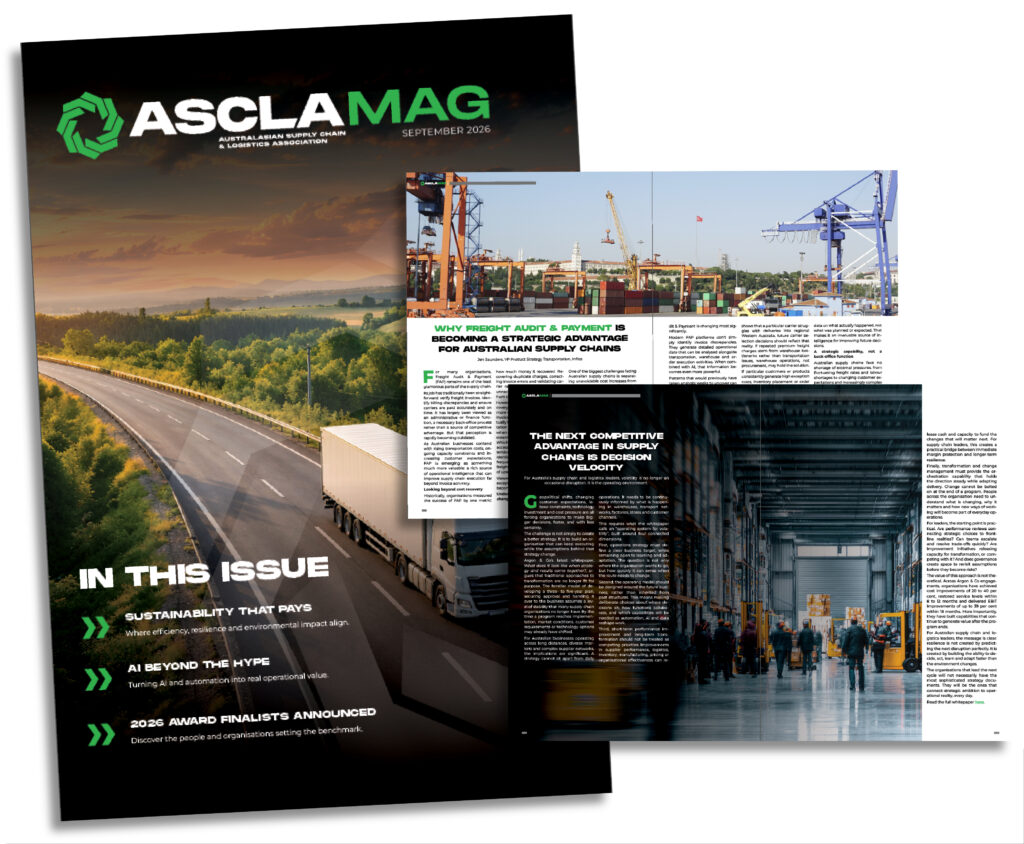
ASCLA Mag September 2026
The September 2026 edition of ASCLA Mag explores how sustainability is becoming a practical business advantage across Australasia’s supply chain and logistics industry. As AI, data and operational innovation reshape how goods are planned, moved and delivered, this edition examines the strategies helping organisations reduce waste, improve efficiency, strengthen freight resilience and build the workforce…
Data Centres and the Squeeze on Logistics Land
By Steven Ballerini | CEO of Australasian Supply Chain & Logistics Association (ASCLA) For most of the past decade, the competition for industrial land on the fringes of Sydney and Melbourne was a contest between logistics operators, manufacturers and the developers who built for them. That contest has acquired a new and considerably better-funded participant.…
Celebrating an Industry That Rarely Celebrates Itself
By Steven Ballerini | CEO of Australasian Supply Chain & Logistics Association (ASCLA) On Friday 23 October the industry will gather at Brisbane City Hall for the ASCLA Industry Awards, and for the first time in more than six decades of the awards the night will be held in Brisbane. Six decades is a long…