

Why Transport Belongs at the Centre of Australia’s Innovation Agenda

By Steven Ballerini | CEO of Australasian Supply Chain & Logistics Association (ASCLA)
In August, ASCLA joined 23 other national organisations spanning rail, road, heavy vehicles, freight, logistics, engineering and research in a joint letter to Senator the Hon Tim Ayres, Minister for Industry and Innovation and Minister for Science, asking the Australian Government to recognise transport as a seventh National Innovation Pillar. The coalition, coordinated by the Australasian Railway Association, includes the Australian Logistics Council, iMOVE CRC, the National Transport Research Organisation, Engineers Australia, the Freight & Trade Alliance, Heavy Vehicle Industry Australia and several of the country’s leading university transport research centres. Two months on, the campaign has broadened considerably. The ARA has since written to the Commonwealth infrastructure department and to the transport agencies in New South Wales, Victoria, Queensland, South Australia and Western Australia seeking their support, and the coalition is pressing for a follow-up meeting with the Minister. It is a good moment to explain to members what is being asked for, why it matters to the supply chain profession, and how you can help.
What Ambitious Australia Proposes
The proposal responds to Ambitious Australia: Strategic Examination of Research and Development, the Government’s review of the national research and innovation system. The review recommends concentrating effort around a small number of long-term National Innovation Pillars, each anchored by an aspirational national goal, supported by up to three subgoals and delivered through National Strategic Initiatives that bring government, industry, researchers, start-ups and investors together. The Government has since established the National Resilience and Science Council to coordinate public innovation investment and align more than $39 billion of Commonwealth R&D commitments with the nation’s economic objectives.
The six pillars proposed in the review cover technology, energy and the environment, resources, agriculture and food, health and medical, and defence. Transport touches every one of them, as the system that carries agricultural and resource exports, delivers medical supplies, moves defence logistics and consumes a growing share of the nation’s energy, yet it does not have a pillar of its own. That omission is notable given that transport was named as one of Australia’s nine National Science and Research Priorities in 2015, and the challenges facing the sector have only intensified since then. The coalition’s argument is that without dedicated recognition, transport research will continue to be fragmented across modes and jurisdictions, promising trials will struggle to scale beyond a single project, and Australian suppliers will lack a clear pathway to commercialise what they develop.
A Productivity Problem Hiding in Plain Sight
The economic case is substantial. Transport, postal and warehousing accounted for 4.5 per cent of GDP in 2024–25 and directly employs around 726,000 Australians, and once the transport activity embedded in mining, construction, wholesale and retail is included, the footprint rises to as much as 10 per cent of GDP and 1.3 million workers. Despite record public investment, however, transport multifactor productivity has fallen below its 2012–13 level and remained there. Analysis by iMOVE and Tulipwood Economics estimates that restoring productivity to that benchmark would leave the economy around $14.6 billion larger by 2040, while the same work puts the cost of congestion at around $25 billion in 2024–25 alone. The Productivity Commission has reached a similar conclusion for road freight, noting in its 2026 interim report on heavy vehicle reform that physical productivity has stalled for more than a decade.
The investment side of the ledger makes the opportunity sharper still. Infrastructure Australia’s 2025 market capacity report identifies a $242 billion five-year Major Public Infrastructure Pipeline, of which transport accounts for $129 billion, or 53 per cent. Importantly, the coalition is not asking for more infrastructure funding. It is asking for a mechanism that extracts more value from assets and programs already funded, through better network management, construction productivity, asset performance, interoperability, digitalisation and automation. Applied across a system of that scale, even modest gains would be worth billions. Other economies have already drawn that conclusion, with Singapore committing S$800 million in July this year to a five-year transport and connectivity research program spanning land, air and sea.
Why This Matters to Supply Chain Professionals
For our members, the most important feature of the proposal is that it is deliberately multimodal. Freight does not move by a single mode, and the performance of an end-to-end supply chain depends on how well road, rail, ports, airports, intermodal terminals and the data that connects them work together. The proposal points to examples where that integration has paid off, including road upgrades enabling greater use of B-doubles that delivered freight efficiency gains of 15 to 30 per cent, and the Murray Basin Rail Plan, which allowed grain trains to carry an additional 1,000 tonnes, a 50 per cent uplift. Gains like those come from combining infrastructure, vehicle standards, network access, regulation and operating practice, which is exactly the kind of cross-cutting problem a national pillar is designed to address.
The same is true of decarbonisation and resilience. Transport produced 23 per cent of Australia’s greenhouse gas emissions in 2025 and is expected to become the largest emitting sector by 2030 without further action, and the solutions, whether electrification, alternative fuels, mode shift or operational efficiency, cannot be resolved one project at a time. The disruptions of recent years have also shown how quickly fragile networks translate into empty shelves and lost exports, and how much the country depends on the ability to shift freight between modes when a route is cut.
ASCLA’s role in the coalition reflects what our membership brings that research institutions and infrastructure owners cannot. Our members are the practitioners who take new technology, new data and new operating models and make them work on a warehouse floor, in a transport yard or across a national network. A pillar that builds stronger pathways from research to implementation needs that practical capability, along with the workforce development and professional education that ASCLA provides, if the research is ever going to reach everyday supply chain practice.
The Final Word
The decision now being sought from the Commonwealth is one of strategic recognition. The proposal deliberately leaves the pillar’s goals and initiatives open, to be co-designed with government, industry, researchers and workforce representatives once the pillar is recognised, and that is where the supply chain voice will matter most. Until then, what will carry the case forward is visible support from across the industry, and members can contribute directly. I would encourage you to share this article with your colleagues and networks so that more of the profession understands what is being proposed and why it matters. When you see posts about the campaign appearing in your LinkedIn feed over the coming weeks, please take a moment to comment on and reshare them. Decision makers then see support coming from practitioners across the sector and not only from its peak bodies.
If you have an opportunity to raise the proposal through your own engagement with government, whether at a Commonwealth, state or local level, please do so and let us know, as the coalition is keen to hear where conversations are taking place. Australia cannot have a serious national innovation agenda that leaves out the system that moves its people and goods, and the supply chain profession has every reason to make that case loudly.
Sources: Joint stakeholder letter to Senator the Hon Tim Ayres, Recognition of Transport as a National Innovation Pillar, 7 August 2026 (24 supporting organisations; 4.5 per cent of GDP; around 726,000 employed; up to 10 per cent of GDP and 1.3 million workers; more than $39 billion of Commonwealth R&D commitments). National Innovation Pillar – Transport proposal, August 2026, citing iMOVE and Tulipwood Economics, Final Destination: Transport and National Productivity, 2026 ($14.6 billion GDP uplift by 2040; congestion cost of around $25 billion in 2024–25); Infrastructure Australia, 2025 Infrastructure Market Capacity Report, 2025 ($242 billion pipeline; $129 billion or 53 per cent transport); Productivity Commission, Impacts of Heavy Vehicle Reform: Interim Report, 2026; Transport Australia and Scyne Advisory, Valuing Australia’s Transport Network, March 2026 (B-double and Murray Basin Rail Plan outcomes); Australian Government, Transport and Infrastructure Net Zero Roadmap and Action Plan, September 2025 (23 per cent of emissions); Australian Government, Science and Research Priorities and Practical Research Challenges, 2015; Singapore Ministry of Transport, 7 July 2026 (S$800 million research commitment); and Australian Government, Ambitious Australia: Strategic Examination of Research and Development—Final Report, 2026. Australasian Railway Association letters to the Commonwealth Department of Infrastructure, Transport, Regional Development, Communications, Sport and the Arts and to the NSW, Victorian, Queensland, South Australian and Western Australian transport agencies, 21 August 2026, and ARA campaign update and communications toolkit, September–October 2026.
View Similar Blogs
Why Transport Belongs at the Centre of Australia’s Innovation Agenda
By Steven Ballerini | CEO of Australasian Supply Chain & Logistics Association (ASCLA) In August, ASCLA joined 23 other national organisations spanning rail, road, heavy vehicles, freight, logistics, engineering and research in a joint letter to Senator the Hon Tim Ayres, Minister for Industry and Innovation and Minister for Science, asking the Australian Government to…
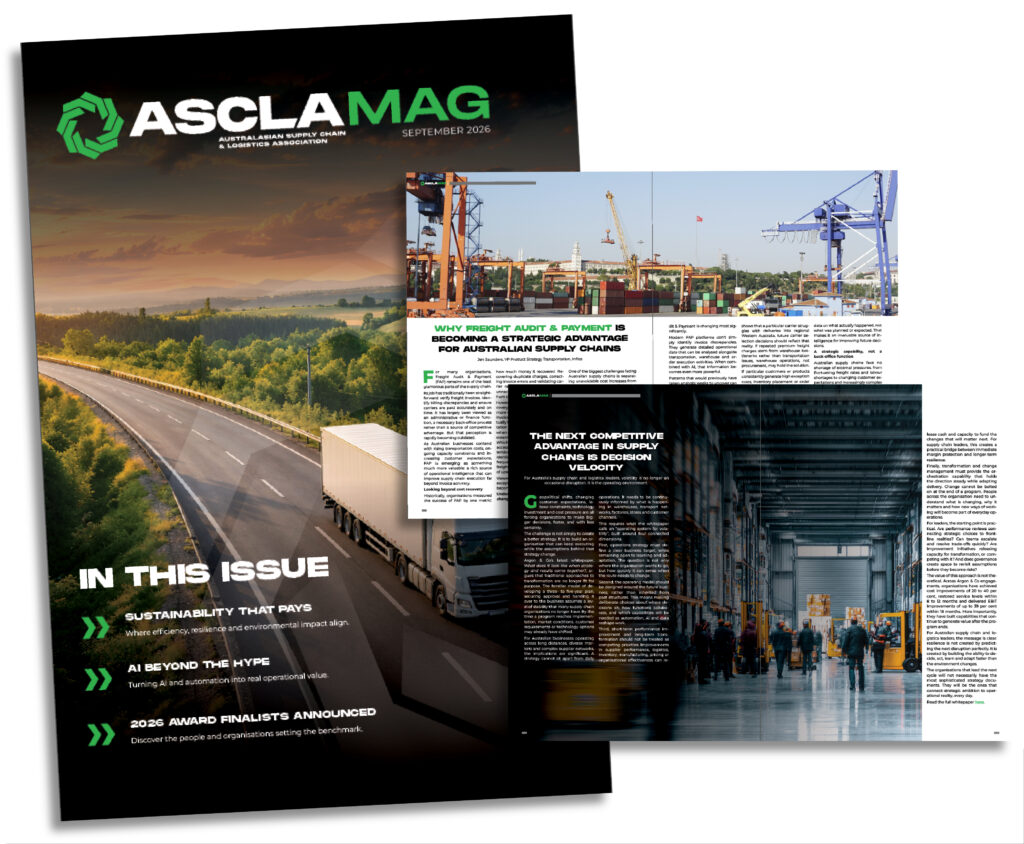
ASCLA Mag September 2026
The September 2026 edition of ASCLA Mag explores how sustainability is becoming a practical business advantage across Australasia’s supply chain and logistics industry. As AI, data and operational innovation reshape how goods are planned, moved and delivered, this edition examines the strategies helping organisations reduce waste, improve efficiency, strengthen freight resilience and build the workforce…

Data Centres and the Squeeze on Logistics Land
By Steven Ballerini | CEO of Australasian Supply Chain & Logistics Association (ASCLA) For most of the past decade, the competition for industrial land on the fringes of Sydney and Melbourne was a contest between logistics operators, manufacturers and the developers who built for them. That contest has acquired a new and considerably better-funded participant.…