

Cleared for Take-Off: What Western Sydney Airport Means for Freight
By Steven Ballerini | CEO of Australasian Supply Chain & Logistics Association (ASCLA)
After fifteen years of planning and seven years of construction, Australia’s first major new airport in more than half a century is about to open its doors. Western Sydney International (Nancy-Bird Walton) Airport, built on Commonwealth land at Badgerys Creek and Luddenham some 44 kilometres west of the Sydney CBD, will begin operations in the second half of 2026.
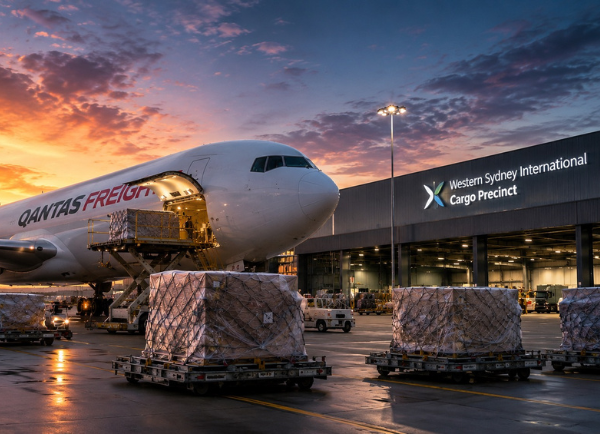
For the travelling public, the story is about a new gateway and the end of a long wait. For our sector, the more important story plays out on the southern side of the airfield, in a purpose-built cargo precinct that will run around the clock from the day it opens.
This is not simply another airport. It is a structural addition to the national freight network, and it changes the calculus for any business that moves time-sensitive goods through New South Wales.
A Staggered Take-Off
The rollout is deliberately phased, and freight goes first. The airport’s 24-hour Cargo Precinct opens for operations on 26 July 2026, with Qantas Freight becoming the first airline to fly out of the new airport when its inaugural freighter departs on the evening of Monday 27 July. Passenger services follow three months later, with Jetstar operating the first commercial flight to the Gold Coast at 11am on Sunday 25 October. Air New Zealand begins Auckland services the following day, and Singapore Airlines launches daily flights to Changi on 23 November.
Putting cargo ahead of passengers is a sensible way to commission a greenfield airport, allowing systems, staff and ground handling to be tested under real conditions before the terminal fills with travellers. It also means freight customers will have several months of operating history behind them before the passenger network even begins.
One date matters more than the rest for our sector. From 1 November 2026, Western Sydney is intended to become Sydney’s airport for overnight aircraft movements. That is the moment the new airport’s defining advantage comes into force.
The Curfew-Free Edge
Sydney Kingsford Smith has operated under a legislated curfew since 1995. Most aircraft movements are prohibited between 11pm and 6am, and the airport is further constrained by an eighty-movement hourly cap. For three decades, that curfew has been the single biggest argument for a second Sydney airport.
Western Sydney International will operate curfew-free, 24 hours a day. For freight, this is the whole game. Air cargo lives and dies on overnight movements: the late-night departure that connects to an early-morning international service, the red-eye freighter that has goods on shelves before trading opens. A curfew-free airport on the east coast, in the same time zone as the nation’s largest consumer market, removes a constraint that operators have engineered around for a generation.
The capacity uplift is immediate. The cargo precinct opens with the ability to handle at least 220,000 tonnes of freight a year and to service eight wide-body aircraft simultaneously, lifting Sydney’s total air cargo capacity by around a third from day one. The longer-term trajectory is steeper still: the Sydney air freight task is projected to grow from around 650,000 tonnes a year today to roughly 1.4 million tonnes by 2045, and the precinct has been built to scale into that demand.
Inside the Cargo Precinct
The precinct has drawn the industry’s heavy hitters, and it is already close to fully leased. Qantas Freight anchors the site with a 24,000 square metre footprint and a fleet of upgraded Airbus A321 and A330 freighters, and expects to move more than 850 tonnes of freight through the airport each week. Global handler dnata is investing around $32 million in a dedicated terminal geared to pharmaceuticals and other temperature-sensitive shipments. Menzies Aviation has taken a twenty-year lease on a facility designed to handle in excess of 150,000 tonnes a year across cool-chain, e-commerce and heavy cargo. Behind them sit memoranda of understanding with a who’s who of the sector, from Australia Post and StarTrack to DB Schenker, DHL Express, DSV, FedEx and Toll.
The common thread is specialisation in exactly the goods that depend on speed and reliability: pharmaceuticals, perishables, electronics and e-commerce parcels. For exporters of high-value produce and seafood, and for importers of medical and high-tech goods, the precinct offers something Sydney has not had before — dedicated, round-the-clock cargo infrastructure with direct connectivity between freighter, terminal and truck.
The Road Connection
An airport is only as useful as the network that feeds it, and this is where the Western Sydney location earns its keep. The precinct sits beside the toll-free M12 Motorway and the upgraded Northern Road, within easy reach of the established freight and logistics hubs at Kemps Creek and the broader Aerotropolis. In June 2026, the federal and NSW governments committed a further $600 million to bring forward upgrades to Elizabeth Drive and Fifteenth Avenue, two arterials that carry freight to and from the airport, with work now starting a full year ahead of schedule.
The strategic value extends well beyond Sydney. As Beau Paine, Global Head of Cargo at Menzies Aviation, has noted, a great deal of freight currently arrives in Sydney and is then trucked on to other capitals — and from the western suburbs, “that quicker access to the freeways is an added advantage” for road freight heading to Brisbane and Melbourne. An airport positioned on the western edge of the city, closer to the interstate motorway network, shortens the road leg for freight that never had Sydney as its final destination in the first place. Over time, the planned Sydney Metro rail link and the proposed Western Sydney Freight Line will add further capacity, but the road network is doing the heavy lifting from day one.
What It Means for Shippers
For supply chain leaders, the opening is an invitation to revisit some settled assumptions.
Reconsider your overnight options. If your freight model has been built around the Kingsford Smith curfew, a 24-hour airport opens scheduling windows that simply did not exist before. Time-critical and internationally connecting cargo is where the gains will be largest.
Map your road legs, not just your air legs. The advantage of the western location depends on where your freight is actually going. For consignments bound for Brisbane, Melbourne or regional NSW, proximity to the motorway network may matter more than proximity to the CBD.
Watch the capacity story closely. A one-third lift in Sydney’s air cargo capacity, in a market that has been chronically constrained, should ease pressure and sharpen competition over time. That is worth factoring into freight procurement and carrier negotiations.
Treat it as a network change, not a single facility. A new curfew-free node on the east coast reshapes how the whole eastern seaboard freight task can be planned. The operators who think in those terms first will be the ones who capture the advantage first.
The Final Word
Australia does not open a major new airport very often. The last one of this scale predates almost everyone working in the sector today. Western Sydney International arrives at a moment when the freight network is under real cost and capacity pressure, and it brings something genuinely new to the table: round-the-clock operations, serious cargo infrastructure and a location built for the road network of the next half-century.
The passenger terminal will get the headlines and the ribbon-cutting. But the quieter story on the southern apron — where the freighters will be working through the night long before the first holidaymaker checks in — is the one that matters most for our sector. For shippers willing to rethink how and when their freight moves, the opportunity is cleared for take-off.
Sources
Prime Minister of Australia and Minister for Infrastructure, Transport, Regional Development and Local Government, media releases, “It’s official – Western Sydney to open to passengers on 25 October and freight on 26 July 2026,” June 2026 (opening dates; Jetstar, Air New Zealand and Singapore Airlines schedules; curfew-free operations; 1 November 2026 night-movement gazettal; near $18 billion Western Sydney investment); Department of Infrastructure, Transport, Regional Development, Communications, Sport and the Arts, “About Western Sydney International Airport” and “Western Sydney Airport set to open,” 2026 (construction timeline; WSA Co Limited; curfew-free freight and passenger services); Qantas Newsroom, “Qantas Freight Joins Western Sydney International Airport’s New 24-Hour Cargo Precinct” (24,000 sqm footprint; Airbus A321 and A330 freighters; circa 33 per cent capacity uplift; precinct jobs); Australian Traveller, June 2026 (Jetstar JQ362 first passenger flight; 850-plus tonnes of freight a week; public bus services from 5 July 2026); Asian Aviation, Aviation Business News and Stat Times, April 2026 (dnata A$32 million terminal; 60,000-tonne facility; 220,000-tonne precinct capacity; eight wide-body aircraft stands); Air Cargo News and Payload Asia, 2024 (Menzies Aviation 22,500 sqm facility and twenty-year lease, in excess of 150,000 tonnes a year; Beau Paine, Global Head of Cargo, Menzies Aviation); MHD Supply Chain, “$600m road funding to accelerate Western Sydney airport links,” June 2026, and PS News, “Federal and NSW governments combine for $600m boost to Western Sydney roads,” June 2026 (Elizabeth Drive and Fifteenth Avenue upgrades brought forward); Australian Financial Review, cargo hub coverage, 2025–26 (Beau Paine on road freight to Brisbane and Melbourne; air freight task projected to rise from around 650,000 tonnes a year to about 1.4 million tonnes by 2045); Sydney Airport Curfew Act 1995 (11pm–6am curfew and movement cap at Sydney Kingsford Smith).
View Similar Blogs

Why Transport Belongs at the Centre of Australia’s Innovation Agenda
By Steven Ballerini | CEO of Australasian Supply Chain & Logistics Association (ASCLA) In August, ASCLA joined 23 other national organisations spanning rail, road, heavy vehicles, freight, logistics, engineering and research in a joint letter to Senator the Hon Tim Ayres, Minister for Industry and Innovation and Minister for Science, asking the Australian Government to…
ASCLA Mag September 2026
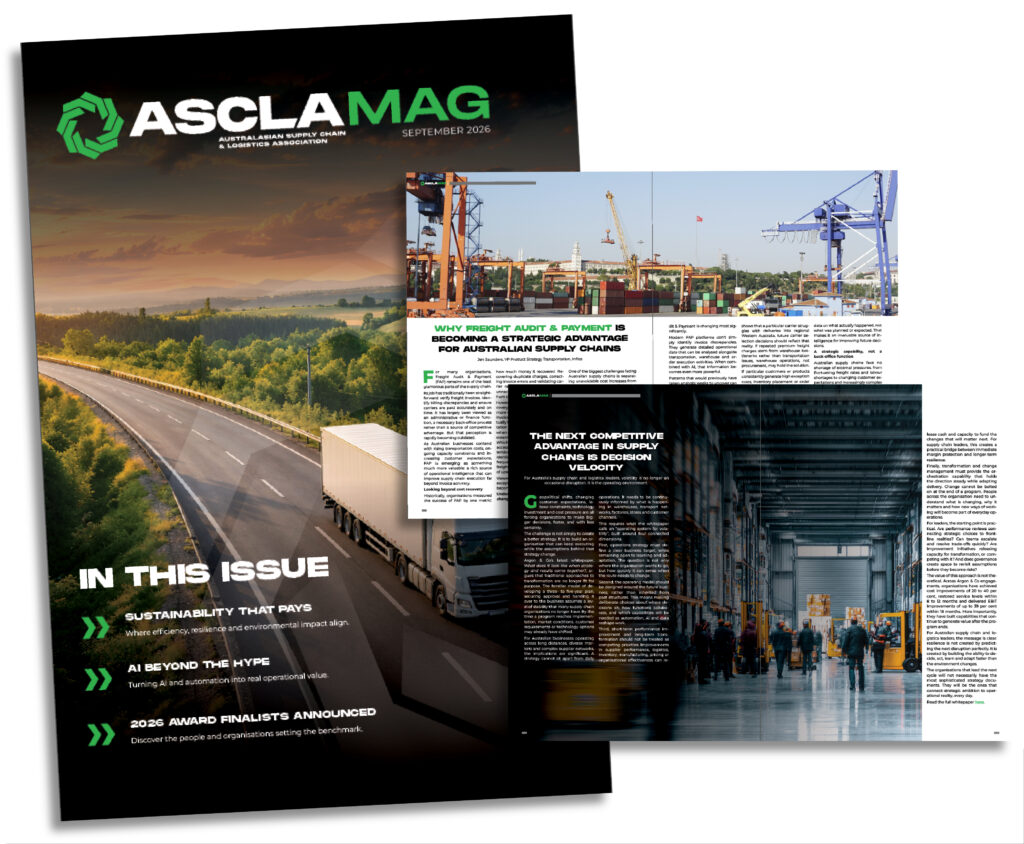
The September 2026 edition of ASCLA Mag explores how sustainability is becoming a practical business advantage across Australasia’s supply chain and logistics industry. As AI, data and operational innovation reshape how goods are planned, moved and delivered, this edition examines the strategies helping organisations reduce waste, improve efficiency, strengthen freight resilience and build the workforce…

Data Centres and the Squeeze on Logistics Land
By Steven Ballerini | CEO of Australasian Supply Chain & Logistics Association (ASCLA) For most of the past decade, the competition for industrial land on the fringes of Sydney and Melbourne was a contest between logistics operators, manufacturers and the developers who built for them. That contest has acquired a new and considerably better-funded participant.…