

Humanoids Are Coming to the Warehouse
By Steven Ballerini | CEO of Australasian Supply Chain & Logistics Association (ASCLA)
Humanoid robots have spent the past few years doing plenty of impressive things. They have walked across stages, carried boxes at technology conferences, performed backflips and appeared in a steady stream of promotional videos promising to transform the way we work. What they have done comparatively little of is work itself, and for supply chain professionals that distinction has mattered more than any demonstration reel. Over the past twelve months, however, a small number of operators have begun putting humanoids into live facilities and reporting what happened.
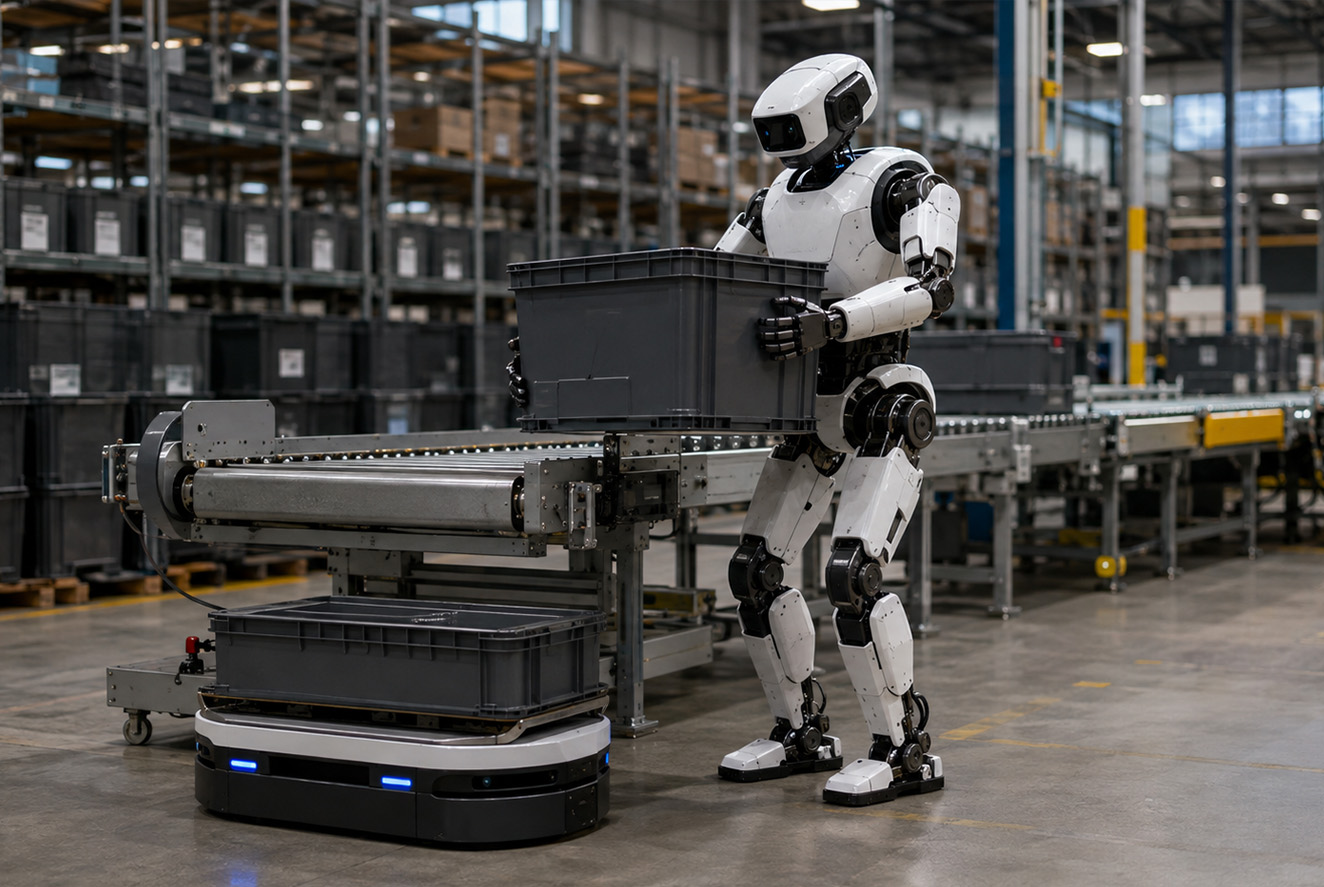
The clearest example sits at a GXO Logistics fulfilment centre in Flowery Branch, Georgia, where Agility Robotics’ Digit has now moved more than 100,000 totes in a live operation, transferring inventory from autonomous mobile robots onto conveyor. The figure matters less for its scale than for its repetition, because one hundred thousand cycles of the same defined task is enough for an operator to begin measuring reliability, intervention rates and cost per task. That is precisely the information the sector has been unable to produce until now.
From Demonstration to Deployment
GXO has been among the more systematic operators in testing the technology. It ran an initial proof of concept with Digit in late 2023, went on to sign what the companies described as the industry’s first multi-year commercial Robots-as-a-Service agreement for humanoid robots in mid-2024, and has since tested units from other manufacturers, including Apptronik’s Apollo and Reflex, alongside staff. Agility has followed with deployments at Schaeffler in Germany, Toyota Motor Manufacturing Canada and, from December last year, Mercado Libre’s fulfilment centre in San Antonio, Texas. Across its customer base it has now disclosed more than 65,000 hours of real-world operation, which is a more useful measure of maturity than any individual deployment announcement.
Figure AI has produced the most striking operating data so far. In May the company ran three of its robots continuously for more than 24 hours sorting parcels, processing over 28,000 packages at approximately three seconds each, a rate it describes as comparable with human performance on that task, with no teleoperation and, on the company’s account, no failures. Figure robots have since progressed into a logistics sequencing role at BMW’s Spartanburg plant in the United States.
Other trials suggest the near-term applications may be broader than picking and carrying. A wheeled humanoid handled tote-to-conveyor destacking at a Siemens electronics plant at 60 moves an hour with a success rate above 90 per cent, while in April Accenture, SAP and Vodafone Procure & Connect ran a humanoid through a warehouse in Duisburg on inspection duty, taking tasks directly from SAP Extended Warehouse Management and reporting misplaced stock, poor pallet stacking and blocked aisles back into the system.
The Market Has Put a Price on the Sector
Public markets have moved considerably faster than warehouses. On 19 August, Chinese manufacturer Unitree Robotics listed on Shanghai’s STAR Market at an issue price of 150.80 yuan and opened at 1,100 yuan, a gain of 629 per cent that valued the company at roughly US$66 billion, before settling to close the day up 460 per cent. The float raised approximately US$900 million against a pricing valuation near US$9 billion, on 2025 revenue of 1.71 billion yuan and shipments of more than 5,000 humanoids. The enthusiasm is not confined to China, with Agility Robotics agreeing in July to list on the Nasdaq through a US$2.5 billion merger while disclosing that it burned around US$100 million in cash last year and remains unprofitable. The distance between those valuations and the operating evidence is the central tension in this sector at present, and it is worth keeping in view when assessing vendor claims.
Why Does a Warehouse Robot Need to Look Human?
There is a reasonable question underneath all of this, given that warehouses already have autonomous mobile robots, conveyors, automated storage systems and robotic arms that perform their specific tasks faster and more reliably than any humanoid currently can. The argument for the human form is that warehouses were built for people, with aisles, shelving, workstations, totes and processes that evolved around the dimensions and movements of the human body. Most conventional automation therefore requires the facility to adapt to the machine, which is why implementation costs are substantial and reconfiguration becomes expensive when product mix or processes change.
The proposition behind the humanoid is that the machine eventually adapts to the facility instead, moving between tasks using infrastructure that already exists. Deloitte describes this as adaptive efficiency and identifies five structural pressures that make it attractive: labour volatility, constraints on space and planning approvals, growth in SKU counts and order complexity, unpredictable throughput, and the poor utilisation of single-task automation. That flexibility is the commercial case for the technology, and it remains the element yet to be demonstrated at scale.
The Reality Is Still Some Distance Behind the Hype
The production and deployment figures remain sobering. Interact Analysis estimates that more than 20,000 humanoids were produced globally in 2025, roughly ten times the previous year’s output, but that only around 10 per cent went into genuine real-world applications, with the balance used for research, data collection and entertainment. The firm does not expect broad commercial viability within five years and places the likely inflection point after 2032.
The physical constraints explain much of that. Current humanoids typically operate for two to four hours between charges, against 10 to 20 hours for a well-specified autonomous mobile robot, and most handle only 10 to 15 kilograms comfortably, which excludes a significant proportion of case and carton work. Deloitte assesses current humanoid productivity at between 30 and 50 per cent of a human performing the same task, and Lennart Held, vice-president of robotics at Infios, describes humanoids as experimental additions within carefully chosen use cases, noting that goods-to-person systems and autonomous mobile robots continue to deliver materially higher return per dollar in the applications they already serve.
The economics follow from those constraints. Deloitte estimates an initial fleet of around five humanoids at between US$800,000 and US$2 million with an indicative payback approaching six years, although each additional robot pays back in roughly two years once the fixed integration cost is absorbed, falling toward seven months by 2030 if hardware costs decline as forecast. Even well-resourced operators are finding this difficult: Amazon unveiled Blue Jay, a multi-arm sortation robot, in October 2025 and discontinued the project in February this year.
Australia Is Watching From the Sidelines
The most relevant finding for our industry is what has not happened here. As at the end of August 2026, no Australian warehouse operator has publicly announced a live humanoid deployment, pilot or proof of concept, and neither the local trade press nor the recent State of Robotics Australia review records one.
That is not a question of availability. Unitree humanoids have been sold here through a local distributor for some time, with more than twenty models listed from around A$12,800 for an entry-level unit to A$302,500 for an inspection platform, and humanoids have already worked at Australian industrial sites, with NASA sending its Valkyrie robot to Woodside Energy in Perth in 2023 to develop remote manipulation capability for offshore facilities. What has not occurred is a deployment inside a distribution centre, and the largest automation investment currently underway in this country reflects that, with Amazon’s AU$750 million robotics fulfilment centre in Brisbane, due to open in 2028, built around purpose-built systems rather than humanoids.
Vendors are nonetheless positioning for the market. Chinese manufacturer AgiBot held its Asia-Pacific partner conference in Melbourne in July and announced a local Robots-as-a-Service network, with initial target markets in mining, commercial cleaning, research and education, and entertainment. Warehousing was not among them, which is notable for a company that had produced its 15,000th robot by June.
Australia does have many of the conditions manufacturers argue favour adoption, including expensive and constrained industrial land, sustained pressure on labour availability across transport, postal and warehousing roles, and a large volume of tasks that sit awkwardly between manual handling and fixed automation. Being a suitable market and being a ready market are not the same thing, however, and operators here will have questions about work health and safety obligations under an ISO framework still being revised, cybersecurity, spare parts and the long-term viability of manufacturers in a fast-moving sector. Those questions became more pointed last month, after the United States Federal Communications Commission banned new imports of foreign-made humanoid and quadruped robots on national security grounds, naming Unitree and AgiBot specifically. With Chinese manufacturers holding an estimated 85 per cent of the global market, Australian buyers can still take delivery of machines their American counterparts cannot, which makes vendor selection a decision about data handling and supply continuity as much as about capability and price.
The Final Word
Humanoids are coming to the warehouse, though the timeframe depends heavily on what is meant by the term. Measured in demonstrations, investment and manufacturer announcements, they have already arrived. Measured in robots working reliably across full shifts, moving between tasks and generating returns competitive with established automation, the sector remains some years away, with the analysts closest to it pointing to the early 2030s rather than the late 2020s.
For Australian operators, the practical implication is a preparation decision rather than a purchasing one. The tasks most likely to suit a humanoid are worth identifying and costing now, while mobile manipulators — an arm mounted on an autonomous base, of the kind DHL is deploying at scale following an agreement for a further 1,000 units — offer a return today and build the orchestration, safety and change-management capability that any later humanoid deployment will require. The governance work, particularly around work health and safety and vendor data practices, is better started early than retrofitted once equipment is on site.
The most useful indicator of progress will remain the ordinary operational measures of totes moved, hours operated, interventions required and cost per task. One hundred thousand totes in Georgia has given the industry its first meaningful set of those numbers, and at some point an Australian operation will produce a set of its own.
Sources
Interesting Engineering, “Agility’s ‘hardest working’ humanoid robot hits 100,000-tote milestone,” November 2025 (more than 100,000 totes moved by Digit at GXO Logistics’ Flowery Branch, Georgia facility; transfer from autonomous mobile robots to conveyor); Agility Robotics and GXO Logistics, “GXO Signs Industry-First Multi-Year Agreement with Agility Robotics,” June 2024 (late-2023 proof of concept; first multi-year commercial Robots-as-a-Service agreement for humanoid robots); Deloitte, “The rise of humanoid robots in warehouses: structural shift or temporary hype?” humanoid robotics series, Booklet 1, 2026 (GXO testing of Apptronik’s Apollo and Reflex units); GeekWire, “‘Digit’ maker Agility Robotics to go public in $2.5B deal — here’s what the filings say about its finances,” July 2026 (customers including Schaeffler, GXO, Toyota Motor Manufacturing Canada and Mercado Libre; more than 65,000 hours of real-world operation; US$2.5 billion merger valuation; approximately US$100 million of cash burned in 2025; more than US$300 million in committed multi-year orders); DC Velocity, “Agility’s Digit humanoid robot transforms Texas fulfillment center,” December 2025 (Mercado Libre San Antonio deployment); Interesting Engineering, “Figure AI humanoids sort 28,000 packages in 24-hour autonomous test,” May 2026 (three robots; more than 28,000 packages; more than 24 hours of continuous autonomy; approximately three seconds per package; no teleoperation); Figure, “F.03 Arrives at BMW,” June 2026 (logistics sequencing role at BMW Group Plant Spartanburg following earlier production deployment); Interesting Engineering, “HMND 01: UK humanoid robot shows logistics readiness at Siemens plant,” 2026 (tote-to-conveyor destacking at 60 moves per hour; pick-and-place success rate above 90 per cent); Accenture, “Accenture, Vodafone Procure & Connect and SAP Pilot Humanoid Robotics in Warehouse Operations,” April 2026 (Duisburg warehouse inspection pilot; tasks issued through SAP Extended Warehouse Management; detection of misplaced stock, pallet stacking issues and blocked aisles); South China Morning Post, “Unitree Robotics surges 629% to US$66 billion valuation in Shanghai share debut,” 19 August 2026 (issue price of 150.80 yuan; opening price of 1,100 yuan and a 629 per cent gain; opening valuation of about US$66 billion; close up 460 per cent); Fortune, “Unitree, famous for its dancing robots, surges by 460% on its trading debut,” 19 August 2026 (approximately US$900 million raised; US$9 billion pricing valuation; 2025 revenue of 1.71 billion yuan); PBS NewsHour, “U.S. bans foreign-made humanoid robots, targeting China over national security,” 29 July 2026 (Federal Communications Commission ban on new imports of foreign-made humanoid and quadruped robots; Unitree and AGIBOT named; Chinese manufacturers’ approximately 85 per cent share of the global humanoid market; Unitree 2025 humanoid shipments above 5,000 units); Interact Analysis, “Humanoid robot production surges tenfold in 2025, but commercial deployments remain limited” and “Humanoid robot revenue to reach $15bn by 2035,” 2026 (more than 20,000 units produced in 2025 against fewer than 2,000 in 2024; around 10 per cent deployed in real-world applications; commercial inflection point projected after 2032); Supply Chain Management Review, Lennart Held (VP Robotics, Infios), “The value and limitations of humanoid robots in the warehouse of the future,” 2026 (two-to-four-hour runtime against 10 to 20 hours for autonomous mobile robots; comfortable payload of 20 to 30 pounds; higher return per dollar from goods-to-person and AMR systems); Deloitte, “The world of humanoids,” Deloitte Netherlands, 2026 (five structural pressures behind adaptive efficiency; humanoid productivity at 30 to 50 per cent of human performance; US$800,000 to US$2 million for an initial five-robot fleet at approximately six-year payback; two-year incremental payback falling toward seven months by 2030); TechCrunch, “Amazon halts Blue Jay robotics project after less than six months,” February 2026 (October 2025 unveiling; February 2026 discontinuation); DC Velocity, “Robots still making strides in logistics,” 2026 (ISO 26058-1 and ISO 25785-1 revisions covering statically and dynamically stable mobile robots; assessment of the application rather than the robot alone); Robotics Center of Silicon Valley, “State of Robotics Australia 2026,” and a review of Australian trade press to 31 August 2026 (no publicly announced humanoid deployment, pilot or proof of concept in an Australian warehouse or distribution centre); C.R. Kennedy, Unitree product listings, Australia, accessed August 2026 (more than twenty models listed from A$12,760 to A$302,500); The Robot Report, “Why NASA is testing its Valkyrie humanoid in Australia,” 2023, and NASA, “NASA Humanoid Robot to Be Tested in Australia” (Valkyrie at Woodside Energy, Perth; remote dexterous manipulation for offshore energy facilities); eWeek, “Inside Amazon’s $536M robotic warehouse,” 2026 (AU$750 million Brisbane fulfilment centre due to open in 2028; Hercules, Sparrow and Vulcan systems; no humanoid systems announced); PR Newswire, “AGIBOT Brings APC 2026 to Australia and New Zealand,” 17 July 2026 (Melbourne partner conference; local Robots-as-a-Service network; mining, commercial cleaning, research and education, and entertainment target markets; 15,000th robot produced by June 2026); Boston Dynamics and DHL Group, “DHL Group signs MOU with Boston Dynamics for additional 1,000-robot deployment,” May 2025. Details accurate as at 31 August 2026.
View Similar Blogs

Why Transport Belongs at the Centre of Australia’s Innovation Agenda
By Steven Ballerini | CEO of Australasian Supply Chain & Logistics Association (ASCLA) In August, ASCLA joined 23 other national organisations spanning rail, road, heavy vehicles, freight, logistics, engineering and research in a joint letter to Senator the Hon Tim Ayres, Minister for Industry and Innovation and Minister for Science, asking the Australian Government to…
ASCLA Mag September 2026
The September 2026 edition of ASCLA Mag explores how sustainability is becoming a practical business advantage across Australasia’s supply chain and logistics industry. As AI, data and operational innovation reshape how goods are planned, moved and delivered, this edition examines the strategies helping organisations reduce waste, improve efficiency, strengthen freight resilience and build the workforce…
Data Centres and the Squeeze on Logistics Land
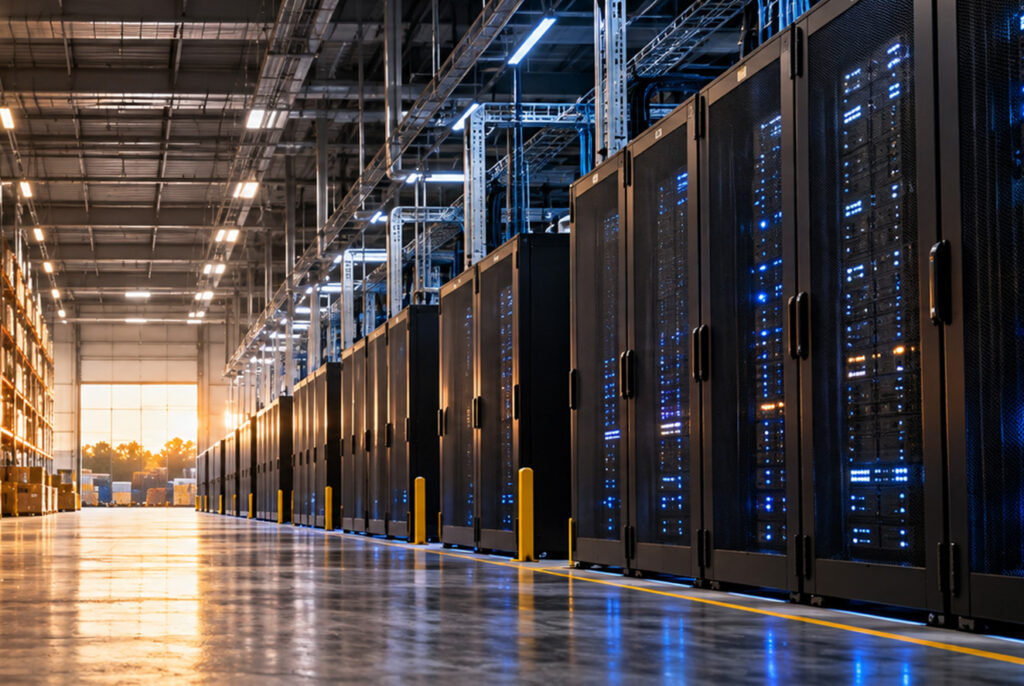
By Steven Ballerini | CEO of Australasian Supply Chain & Logistics Association (ASCLA) For most of the past decade, the competition for industrial land on the fringes of Sydney and Melbourne was a contest between logistics operators, manufacturers and the developers who built for them. That contest has acquired a new and considerably better-funded participant.…