

Running out of Road: The Great Logistics Shakeout

By Steven Ballerini | CEO of Australasian Supply Chain & Logistics Association (ASCLA)
The Australian logistics sector has spent the past three years talking about resilience. The conversation has fixed on disruption, labour shortages, geopolitical risk and the growing complexity of global trade. Beneath all of it sits a simpler and more uncomfortable reality.
Too many businesses in this sector are running out of money.
Insolvencies across the country’s transport and logistics sector have climbed to levels not seen in more than a decade, and across the Pacific a prolonged freight recession continues to push carriers into bankruptcy at a steady clip. What began as a correction after the post-pandemic freight boom has hardened into a structural problem for operators of every size.
This is no longer a question of whether the sector is under pressure. It is a question of which businesses are built to survive it.
The Numbers Behind the Headlines
The trend in the official data is hard to argue with. ASIC figures show insolvency appointments in the Transport, Postal and Warehousing sector rose from 196 in FY22 to 347 in FY23 and then to 495 in FY24, a 153 per cent increase in just two financial years. Closure data since then points to pressure remaining elevated, putting the sector on track for another record year.
The road freight picture is starker still. CreditorWatch data, cited in Grant Thornton’s March 2026 analysis, found that 8.46 per cent of Australian road transport operators exited the market in the twelve months to November 2025, around 40 per cent higher than the year before. Put plainly, roughly one in every twelve road transport businesses stopped trading inside a single year. Grant Thornton’s read on this is the important part. It is not a demand-driven downturn. Freight volumes remain supported by population growth, infrastructure spending and steady domestic consumption. The pressure is structural.
Why Operators Are Failing
The cost base has reset, and it has reset permanently. Fuel remains volatile. Insurance premiums keep climbing in a tighter underwriting market. Labour costs have lifted across driving, warehousing and management, with award wages up 5.75 per cent in 2023 and compulsory superannuation rising from 10 per cent in FY22 to 12 per cent in FY26, a 20 per cent increase in on-costs over four years. Heavy vehicle tolls rise annually under indexed pricing. Financing remains expensive despite the recent easing in interest rates.
At the same time freight rates have failed to keep pace. Many operators spent the boom years competing hard on price to win volume, a strategy that falls apart the moment demand softens and every input cost moves the other way. The asset side has turned too. Second-hand truck values, which surged 50 to 60 per cent during the pandemic supply squeeze, have since fallen sharply, with some older assets down as much as 70 per cent. Operators who geared up at the top of that market are now servicing debt against collateral worth a fraction of what they paid.
The Freight Recession Across the Pacific
The United States offers a useful preview of where sustained margin pressure leads. The American trucking sector has spent close to three years in what the industry now calls the Great Freight Recession. Long-haul truckload demand fell by around 25 per cent in the first half of 2025, while operating costs sat near US$2.27 a mile and insurance premiums rose more than 12 per cent year on year.
The attrition has been brutal and broad. An estimated 88,000 trucking authorities were revoked in 2023, followed by a net contraction of nearly 10,000 carriers in the first half of 2024 alone. Names with deep history have not been spared. Yellow Corporation shut down in 2024 after almost a century of operation, postal contractor 10 Roads Express wound down by January 2026 after 47 years and 2,000 jobs, and the 92-year-old regional carrier Standard Forwarding Freight was liquidated. Larger carriers tend to hold stronger balance sheets and broader customer books, with more room to absorb a lean stretch. Smaller operators rarely have that buffer, and they are the ones exiting first. Analysts at ACT Research expect at least one more shakeout before the market truly rebalances.
Consolidation Is Accelerating
The Australian transport market has always been highly fragmented, with thousands of small and medium operators trading alongside a handful of national providers. As financial pressure builds, that structure is being tested, and operators are facing a narrowing set of choices: grow, merge or exit.
The exits are already on the record. Scott’s Refrigerated Logistics collapsed in 2023, Austrans Container Services followed in 2024, and Arva Logistics in 2025. Lion Global Forwarding also failed, leaving hundreds of containers stranded. Each closure removes capability from the network, but it also creates opportunity. Well-capitalised operators are picking up routes, contracts and fleet assets at distressed valuations, lifting their scale and spreading overheads across a larger base. The businesses with clean balance sheets and disciplined pricing will come out of this cycle materially larger.
What Supply Chain Leaders Should Be Doing Now
- Monitor supplier financial health, not just supplier price. A carrier that wins on rate is worth very little if it is not trading in six months. Build financial health checks into procurement and watch your major freight partners the way a lender would.
- Diversify critical freight lanes. Single-carrier dependency on a key lane is a risk with a real dollar value attached. Spread exposure across more than one provider so a single failure does not strand your freight or your customers.
- Focus on total cost, not lowest cost. The cheapest quote often sits on the weakest balance sheet. The cost of a mid-contract carrier collapse, in scramble freight, service failures and lost customers, dwarfs the few points saved at tender.
- Know the restructuring pathways. For operators under strain, Small Business Restructuring and Voluntary Administration are lifelines rather than death sentences. A fundamentally sound business that is simply stretched can often be reset, but only if the move is made early.
The Final Word
The rise in logistics insolvencies is not a transport industry problem. It is a supply chain problem. Every insolvency represents lost capability, disrupted freight networks, displaced workers and added risk for every customer downstream. The cost base that triggered this shakeout is not returning to where it was, which means the pressure will not lift on its own. The smartest organisations will not wait to find out how resilient their freight partners are. They will act before they become the next statistic.
Sources
ASIC Insolvency Statistics, Transport, Postal and Warehousing sector, FY22 to FY24; Australia’s Transport and Logistics Sector: Facing Structural Margin Pressure and Insolvencies, Grant Thornton Australia, March 2026 (CreditorWatch road transport exit data; award wage, superannuation and toll figures); Breaking Point: The Bumpy Road to Insolvency for Australia’s Transport Sector, Jirsch Sutherland and WA Insolvency Solutions, 2025 (Jimmy Trpcevski; Ian Hyman OAM, Hymans Valuers and Auctioneers, on second-hand truck values; Scott’s Refrigerated Logistics, Austrans Container Services, Arva Logistics, Lion Global Forwarding); Record Insolvencies in Transport Sector, But There Are Lifelines, Big Rigs, May 2025; ASIC Corporate Insolvency Update, Issue 36, 2025 (national insolvency totals); What the 2026 Wave of U.S. Logistics Bankruptcies Tells Us About the Great Freight Recession, AMB Logistic, January 2026; Carrier and Broker Failures in 2024 to 2025 and Why 2026 May Bring One Last Wave, IFA Commercial Factor, January 2026 (FMCSA authority data; ACT Research outlook); Major U.S. Postal Service Trucking Company Shuts Down Business, TheStreet, December 2025 (10 Roads Express; long-haul demand decline); Freight Recession 2026: Is It Finally Over?, HMD Trucking, January 2026 (ATRI operating cost per mile; insurance premiums); May 2026 Trucking Bankruptcies, IndexBox, 2026 (Standard Forwarding Freight); National Freight and Supply Chain Strategy 2025, Australian Government.
View Similar Blogs
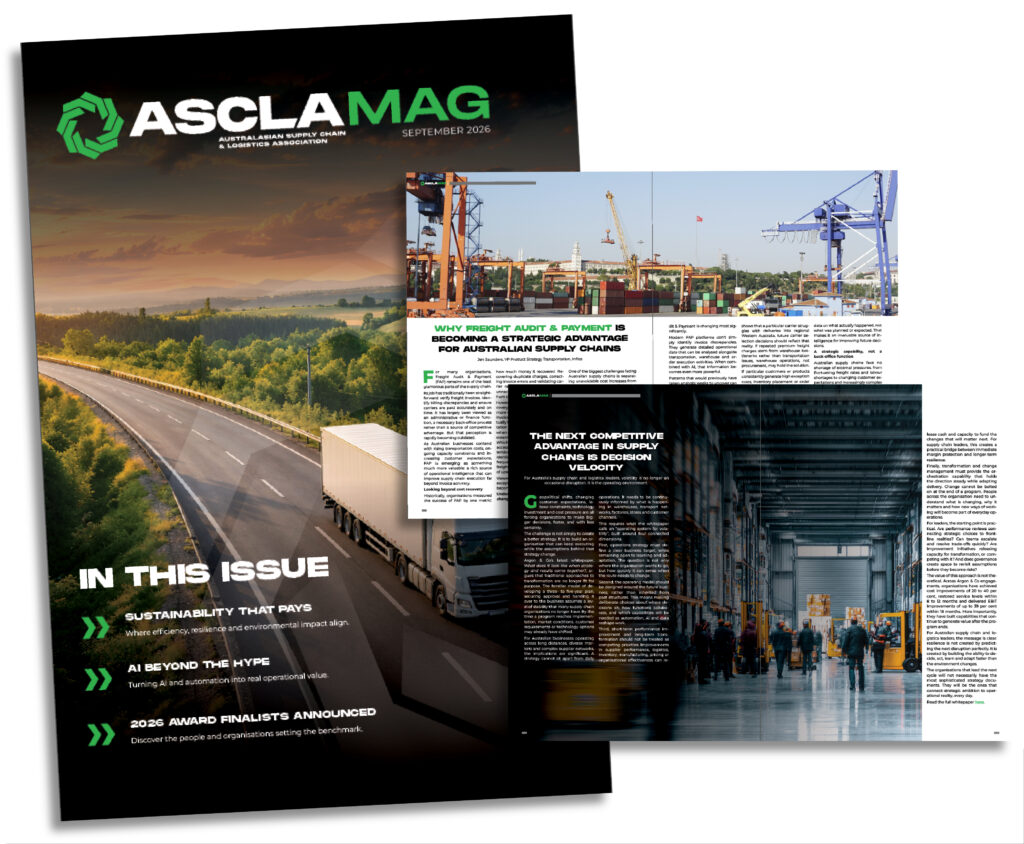
ASCLA Mag September 2026
The September 2026 edition of ASCLA Mag explores how sustainability is becoming a practical business advantage across Australasia’s supply chain and logistics industry. As AI, data and operational innovation reshape how goods are planned, moved and delivered, this edition examines the strategies helping organisations reduce waste, improve efficiency, strengthen freight resilience and build the workforce…

Data Centres and the Squeeze on Logistics Land
By Steven Ballerini | CEO of Australasian Supply Chain & Logistics Association (ASCLA) For most of the past decade, the competition for industrial land on the fringes of Sydney and Melbourne was a contest between logistics operators, manufacturers and the developers who built for them. That contest has acquired a new and considerably better-funded participant.…
Celebrating an Industry That Rarely Celebrates Itself
By Steven Ballerini | CEO of Australasian Supply Chain & Logistics Association (ASCLA) On Friday 23 October the industry will gather at Brisbane City Hall for the ASCLA Industry Awards, and for the first time in more than six decades of the awards the night will be held in Brisbane. Six decades is a long…