

The Four Questions Defining Intralogistics in 2026
By Steven Ballerini | CEO of Australasian Supply Chain & Logistics Association (ASCLA)
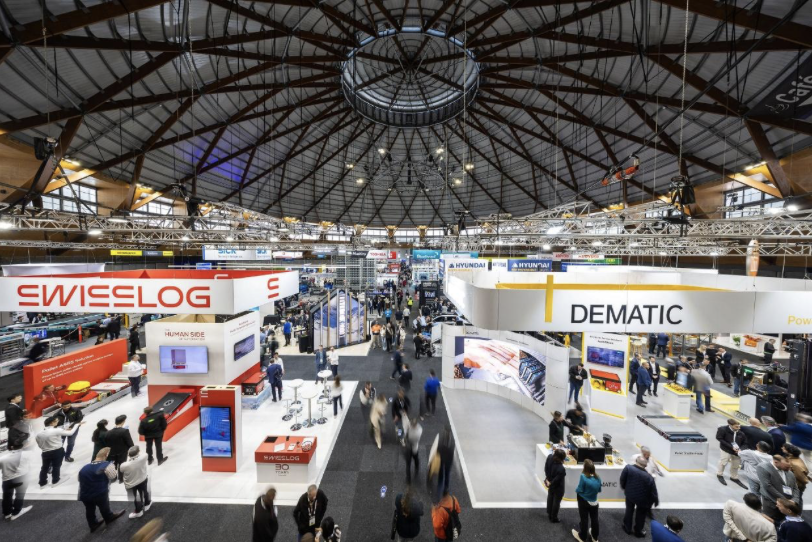
In under a fortnight, the Australian materials handling and intralogistics calendar reaches its centrepiece. CeMAT Australia 2026, hosted by Hannover Fairs, runs from 23 to 25 June at the Melbourne Convention and Exhibition Centre, bringing together the technologies, operators and thinkers shaping how goods move through warehouses, distribution centres and the wider supply chain. ASCLA is the Industry Association Partner of this year’s event, and entry to the exhibition is free for those who register.
An event agenda is always a useful barometer of where an industry’s head is at, and this year’s reads less like a technology showcase and more like a set of open questions. Strip away the session titles and four genuine debates emerge, each one live in boardrooms and on warehouse floors right now. They are worth examining on their own terms, whether or not you make it to Melbourne.
One: If the Technology Is Ready, Why Are the Decisions So Hard?
The global warehouse automation market is forecast to grow from around US$27 billion in 2026 to US$47 billion by 2030. That is an extraordinary amount of capital heading toward conveyors, shuttles, robots and software, and it would be comforting to assume it will all be well spent. Experience suggests otherwise. The pattern repeating across the industry is not failed technology but misdirected investment: automation purchased before the operating model was settled, business cases built on throughput the network never delivers, and solutions sized for a demand profile that shifted before commissioning.
The uncomfortable truth is that the constraint has moved. Vendors have largely solved the engineering. What remains unsolved in many organisations is the decision-making: which problems to attack first, in what sequence, with what capital, and measured against what return. Automation treated as a procurement exercise tends to disappoint. Automation treated as a business design exercise, where the investment follows the strategy rather than leading it, is where the published case studies with genuine payback come from. It is telling that the strongest sessions on this year’s CeMAT program, including the opening keynote and a Swisslog walkthrough of a real AutoStore deployment from business case to live operation, are about exactly this gap between buying technology and deciding well.
Two: AI Has Left the Slide Deck. Has It Reached Your Floor?
For two years the industry conversation about AI ran ahead of the evidence. That gap is now closing quickly. McKinsey research has found that early adopters of AI-enabled supply chain management improved logistics costs by 15 per cent, inventory levels by 35 per cent and service levels by 65 per cent relative to slower-moving competitors. Those are not modelling assumptions. They are observed differences between organisations that scaled AI into live operations and those that stayed in pilot mode.
The frontier has also shifted in character. The early use cases were analytical: demand forecasting, slotting optimisation, exception flagging. The emerging generation is operational. Connected intelligence layers are turning collections of isolated machines into responsive operating systems. AI tools are guiding frontline workers in real time rather than reporting on them after the fact. And agentic AI, software that takes actions rather than making recommendations, is beginning to appear in supply chain execution platforms. The practical question for members is no longer whether the technology works but whether their data, integration and change management are in shape to use it. Several CeMAT sessions, from SSI SCHAEFER on connected intelligence to a Dematic and Zebra demonstration of AI-assisted frontline work, offer a chance to see where that bar currently sits.
Three: The Robots Are Getting Bodies. Should Anyone Care Yet?
Humanoid robotics has crossed from science fiction into capital markets. Venture funding into robotics more than tripled between 2023 and 2025 to reach US$40.7 billion annually, and humanoid pilots are now running in logistics and industrial environments across Asia, Europe and the United States. The promise is obvious: a machine shaped like a person can, in theory, work in facilities designed for people, without the rebuild that conventional automation demands.
The sceptic’s case is equally strong. Autonomous mobile robots, a far more mature technology, still trip over the gap between demonstration and deployment, with real-world rollouts routinely exposing integration, safety and process challenges the brochure never mentioned. The sensible posture for most operators is informed patience: understand the technology, track the economics, and resist both the urge to be first and the temptation to dismiss it. This is precisely the debate TMX Transform will host on the final morning at CeMAT, and Dr Sue Keay, Chair of Robotics Australia Group, will set the national context in her keynote. For members forming a view on where robotics fits their network, hearing the argument made live, and being able to interrogate it, beats reading the press releases.
Four: Sustainability and Resilience Have Stopped Being Aspirations
Two disciplines that lived in strategy documents five years ago are now measurable operating practices, and the proof points are local. IKEA Australia has lifted zero emission truck deliveries from 5 per cent in 2022 to more than 80 per cent today, backed by a $4.5 million investment in national charging infrastructure for its delivery partners. The lesson in that journey is not the headline number but the method: a hard target, transparent reporting against it, and a willingness to solve unglamorous constraints like charging access and contractor vehicle financing. Operators electrifying their own MHE fleets are discovering a similar truth, with available electrical infrastructure quietly becoming the binding constraint on fleet growth.
Resilience has followed the same arc from abstraction to discipline. Tariff shifts, regional tensions and rerouted trade flows are no longer scenario-planning inputs; they are this quarter’s operating conditions, with direct consequences for network design, sourcing strategy and inventory policy. ASCLA will host a panel on this at CeMAT on the Wednesday afternoon, featuring WiseTech Global CEO Zubin Appoo alongside leaders from Blue Yonder and Josco, and it is the session this author would least want members to miss. It also leads straight into the evening networking function, which has a logic of its own.
The Final Word
None of these four questions will be settled by the end of June. But they will all be sharper for three days of case studies, contested panels and corridor conversations, which is what a good industry event is actually for. CeMAT Australia 2026 runs 23 to 25 June at MCEC, registration is free, and ASCLA is proud to partner with an event built around the decisions that matter. We encourage all members to attend, and we look forward to seeing you there.
References
CeMAT 2026 Knowledge Theatre Agenda — CeMAT Australia (Hannover Fairs)
https://www.cemat.com.au/cemat-2026-knowledge-theatre-agenda
CeMAT Australia 2026 — Free Visitor Registration
Warehouse Automation Global Market Report 2026 — The Business Research Company / Research and Markets
https://www.researchandmarkets.com/reports/5767469/warehouse-automation-market-report
Succeeding in the AI supply-chain revolution — McKinsey & Company
Scaling the humanoid robotics supply chain into billion-dollar wins — McKinsey & Company (April 2026)
The road ahead: IKEA Australia and the zero emissions journey — IKEA Australia
View Similar Blogs
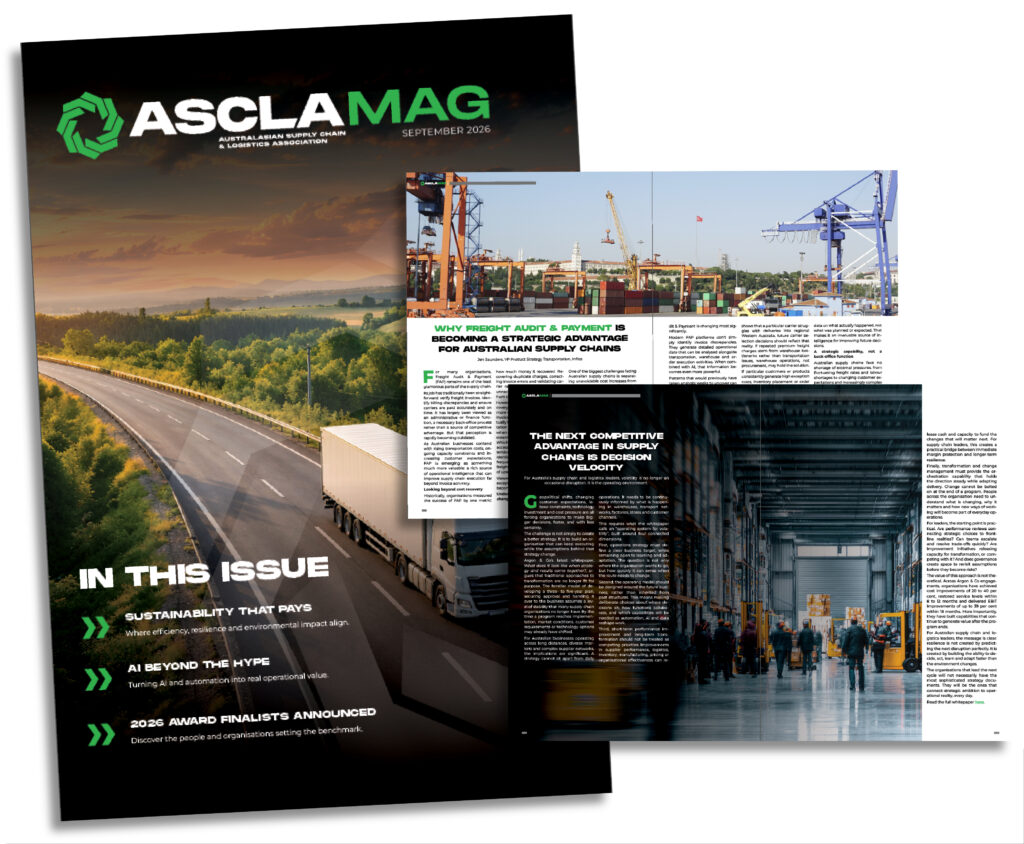
ASCLA Mag September 2026
The September 2026 edition of ASCLA Mag explores how sustainability is becoming a practical business advantage across Australasia’s supply chain and logistics industry. As AI, data and operational innovation reshape how goods are planned, moved and delivered, this edition examines the strategies helping organisations reduce waste, improve efficiency, strengthen freight resilience and build the workforce…

Data Centres and the Squeeze on Logistics Land
By Steven Ballerini | CEO of Australasian Supply Chain & Logistics Association (ASCLA) For most of the past decade, the competition for industrial land on the fringes of Sydney and Melbourne was a contest between logistics operators, manufacturers and the developers who built for them. That contest has acquired a new and considerably better-funded participant.…
Celebrating an Industry That Rarely Celebrates Itself
By Steven Ballerini | CEO of Australasian Supply Chain & Logistics Association (ASCLA) On Friday 23 October the industry will gather at Brisbane City Hall for the ASCLA Industry Awards, and for the first time in more than six decades of the awards the night will be held in Brisbane. Six decades is a long…