
The Panic Buying Trap

By Professor Ben Fahimnia
Panic buying feels like self-protection. When people hear about war, rising fuel prices, or supply disruptions, the instinct is simple: buy more now before things run out or become more expensive. But panic buying rarely protects anyone. In fact, it often accelerates the very shortages people are trying to avoid.
This dynamic is beginning to emerge as global supply chains react to the escalating conflict in the Middle East. Disruptions to energy supply and key shipping routes are already pushing oil prices higher, raising transport costs and putting pressure on the global movement of goods.
The instinct to stock up is understandable. But when millions of people act on that instinct at the same time, supply chains become extremely difficult to manage.
Supply chains run on predictability
Supply chains are built around stable patterns of demand.
Petrol stations, supermarkets, and warehouses do not store unlimited stock. Their storage capacity and delivery schedules are based on what customers typically buy.
A petrol station, for example, might normally sell about 10,000 litres of fuel per day. Deliveries are scheduled to match that pattern.
Supermarkets operate in the same way. They receive regular shipments of groceries and household goods based on predictable shopping behaviour.
This system works very efficiently under normal conditions. But when large numbers of consumers suddenly start buying two or three times more than usual, the system quickly struggles to keep up.
The bullwhip effect
Supply chain researchers have long studied a phenomenon known as the bullwhip effect.
The name comes from the motion of a whip: a small flick of the wrist produces a much larger crack at the tip.
In supply chains, small changes in demand are amplified as they move through the system.
If supermarket sales rise slightly, retailers may increase their orders more significantly to avoid running out of stock. Distributors then increase orders further, and manufacturers respond with even larger production adjustments.
By the time the signal reaches the upstream stages of the supply chain, the original change can appear far larger than it actually is.
When disruption starts with supply
The current disruption, however, is not beginning with demand. It begins with supply.
When oil prices rise or shipping routes become unstable, the cost of transporting goods increases across the entire supply chain. Freight rates rise, delivery costs increase, and manufacturers face higher production expenses.
This supply shock is already sending the first wave of disruption through the global economy. This is the first bullwhip effect form the supply side.
The second shock: consumer behaviour
At the same time, consumers are reacting to the news.
Drivers rush to fill their fuel tanks. Households stock up on groceries and household goods. People buy more than they normally need because they fear shortages or future price increases.
From an individual perspective, this behaviour feels rational. But when millions of consumers act this way simultaneously, the signals sent to the market become distorted.
Retailers see a sudden surge in sales and interpret it as rising demand. To avoid empty shelves, they place larger orders with wholesalers. Wholesalers increase orders to distributors, and distributors increase orders to manufacturers.
What began as precautionary buying is interpreted throughout the system as real demand growth. This is the second bullwhip effect from the demand side.
The “double-whip” effect
When supply disruptions and panic buying occur at the same time, supply chains experience what could be described as a double-whip effect.
The first whip originates from the supply side. Energy disruptions, transport bottlenecks, and geopolitical instability reduce the efficiency of global logistics.
The second whip comes from the demand side. Panic buying sends exaggerated signals back through the supply chain.
These two waves of disruption collide in the middle of the system. The result is volatility, shortages, and price spikes far larger than the original disruption.
The paradox of panic buying
The current disruption is not limited to fuel.
Energy sits at the centre of all supply chains. Trucks, ships, and aircraft that move goods around the world all rely on fuel, and many production systems depend on oil and gas as key inputs. When energy supplies are disrupted, the cost of transporting and producing goods increases across the entire economy.
These higher costs eventually reach consumers, pushing up the prices of food, household goods, and everyday products.
When panic buying spreads across fuel, groceries, and consumer goods at the same time, the pressure on supply chains multiplies.
What feels like an individual strategy for protection becomes a collective behaviour that destabilises the system everyone depends on.
The more consumers try to secure goods for themselves, the more they amplify the shortages affecting everyone.
The solution
Supply chains are complex systems, but stabilising them during disruption requires more than just individual restraint. it requires “coordination” at the national level.
At the consumer level, the principle remains simple: stable and predictable demand allows supply chains to adapt. When households buy roughly what they need, logistics systems can respond far more effectively, even under pressure.
However, in a disruption of this magnitude, behaviour alone is not enough. Fuel supply chains span a highly interconnected system: imports, ports, storage terminals, trucking networks, wholesalers, and retail distribution. These activities are fragmented across federal and state jurisdictions as well as private operators. Without coordination, this fragmentation becomes a major vulnerability.
This is why national-level coordination is not just helpful; it is essential. The government’s move toward a coordinated response is timely, if not overdue. What is needed is a central “control tower” that can align real-time data, synchronise logistics decisions, and prioritise allocation across critical sectors such as freight, food distribution, healthcare, and emergency services. Without this level of coordination, even a manageable disruption can escalate to a national crisis.
What we are facing is not simply a fuel issue; it is a system-wide supply chain stress event. Managing it requires treating it as such: a coordinated, national emergency response to stabilise flows, guide demand, and ensure that limited resources are used where they matter most.
Finally, panic buying may feel like control at the individual level. In reality, stability, supported by strong national coordination, is what keeps the entire system functioning.
Ben Fahimnia is a Professor and Chair in Supply Chain Management at the University of Sydney.
View Similar Blogs
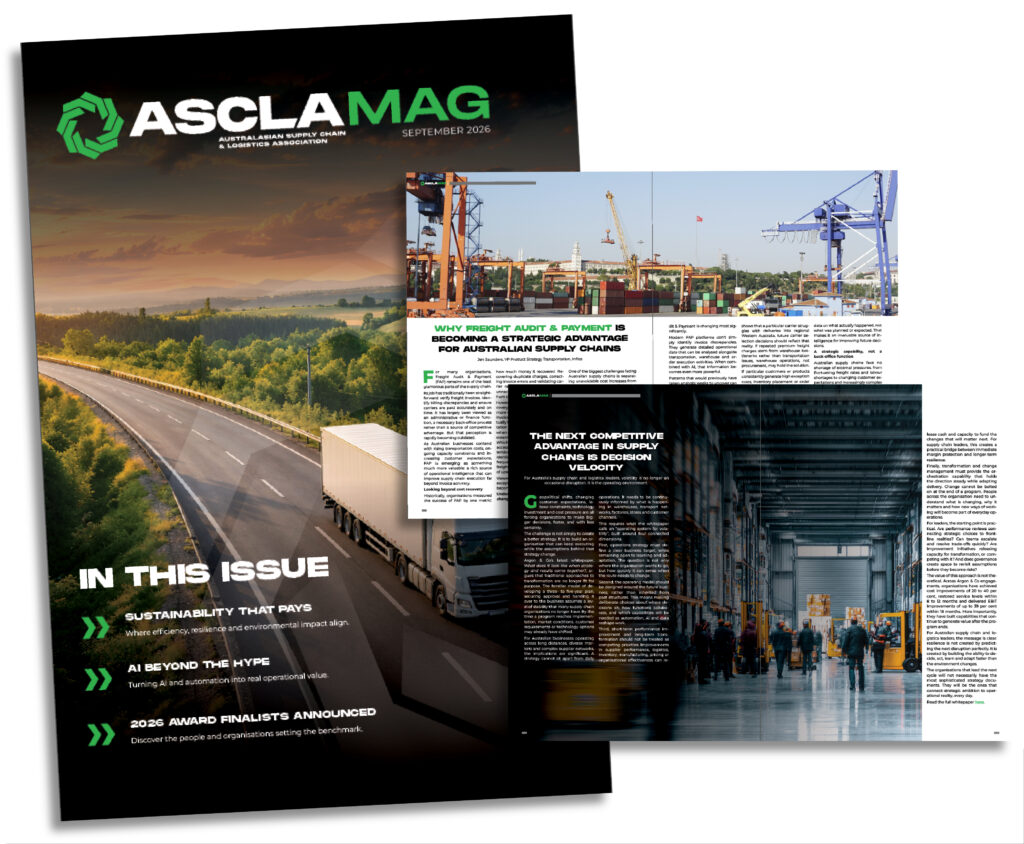
ASCLA Mag September 2026
The September 2026 edition of ASCLA Mag explores how sustainability is becoming a practical business advantage across Australasia’s supply chain and logistics industry. As AI, data and operational innovation reshape how goods are planned, moved and delivered, this edition examines the strategies helping organisations reduce waste, improve efficiency, strengthen freight resilience and build the workforce…
Data Centres and the Squeeze on Logistics Land
By Steven Ballerini | CEO of Australasian Supply Chain & Logistics Association (ASCLA) For most of the past decade, the competition for industrial land on the fringes of Sydney and Melbourne was a contest between logistics operators, manufacturers and the developers who built for them. That contest has acquired a new and considerably better-funded participant.…
Celebrating an Industry That Rarely Celebrates Itself
By Steven Ballerini | CEO of Australasian Supply Chain & Logistics Association (ASCLA) On Friday 23 October the industry will gather at Brisbane City Hall for the ASCLA Industry Awards, and for the first time in more than six decades of the awards the night will be held in Brisbane. Six decades is a long…