

From Industry Demand to Law: What the Fair Work Act Amendments Mean for Road Transport

By Steven Ballerini | CEO of Australasian Supply Chain & Logistics Association (ASCLA)
Australia’s road transport sector has spent weeks absorbing one of the sharpest fuel price shocks in recent memory. Diesel exceeding $3 per litre in some regions, a wave of small trucking business collapses, and a worsening road safety toll have turned a geopolitical conflict in the Middle East into a genuine operational emergency for freight operators the length and breadth of the country.
Out of that pressure has come something less common: a unified industry response. Unions, employer associations, and peak bodies spoke with one voice in demanding emergency legislative action, and the Albanese Government has moved quickly to answer. The Fair Work Act will be amended to allow road transport businesses to make emergency applications for contract chain orders, stripping out the existing six month minimum wait that left operators unable to renegotiate contract terms fast enough to survive rapid cost blowouts.
The Crisis Driving the Change
Iran’s partial closure of the Strait of Hormuz, triggered by US and Israeli military strikes, sent global oil prices sharply higher. The effects landed in Australia quickly. Diesel, already the dominant cost variable for road freight operators, rose by more than 105 cents per litre from the start of the conflict according to Australian Trucking Association data. In some regional areas pump prices pushed past $3 per litre. Energy Minister Chris Bowen confirmed to parliament that over 109 Victorian service stations had run out of at least one grade of petrol, and similar shortages were reported across Queensland and New South Wales.
For road freight operators the impact was immediate. Owner drivers and small trucking businesses run on thin margins and many have no practical ability to impose fuel levies or renegotiate contracts at short notice. The burden landed at the bottom of the supply chain: operators continued delivering for large retail, manufacturing and mining clients while absorbing costs those clients were not sharing.
The numbers this year are stark. Transport company liquidations have risen 48 per cent on the prior year. Thirty people have died in truck crashes on Australian roads, nine of them drivers. Industry groups have consistently argued that when operators cannot recover their costs, safety suffers — schedules get rushed and maintenance gets deferred.
How Industry Responded: A Unified Call for Emergency Powers
What followed was a rare show of industry solidarity. The Transport Workers’ Union, the Australian Road Transport Industrial Organisation, the Australian Trucking Association and the National Road Freighters’ Association came together to call on the Federal Government to amend the Fair Work Act so emergency powers could be deployed by the Fair Work Commission without delay.
This was not a call to create new law from scratch. Back in 2024 the Government had already amended the Fair Work Act to give the Fair Work Commission power to intervene on behalf of workers and businesses in road transport. What the industry was asking for was the ability to use those powers urgently, bypassing a process that under normal circumstances requires a minimum of six months before an order can be made. When businesses are facing collapse in weeks, a six-month clock is not a solution.
TWU National Secretary Michael Kaine was blunt about the stakes. ATA Chief Executive Mathew Munro made clear that businesses operating on the margins typical of road freight simply cannot absorb sustained fuel cost increases and survive.
The joint call was backed by applications to the Fair Work Commission for a formal conference involving dozens of transport businesses and major clients. The signal from that process was felt even before the government responded legislatively. Woolworths and Coles both moved to more frequent fuel levy reviews after receiving notification of proceedings. DoorDash and Didi introduced supplements for drivers, though their approaches differed.
What the Amendment Does
The amendment creates an emergency application pathway for contract chain orders, removing the six-month minimum waiting period. The underlying power already existed: the Fair Work Commission can require transport clients, including retailers, mining companies, and manufacturers, to offer fair contract terms that ensure operators are paid enough to cover their fuel costs. What has been absent is the ability to access that power quickly when conditions move against operators without warning.
The amendment does not rewrite commercial contracts or impose fixed terms on anyone. What it does is create a formal and faster mechanism for resolving cost-sharing disputes across the supply chain when fuel price shocks reach a point where normal commercial processes cannot keep pace.
The structural logic here is worth noting. In road freight, the party bearing the cost of a fuel shock is the transport operator. The party best placed to absorb that cost is often the large commercial client at the top of the chain. That misalignment has been a known vulnerability in Australian freight for years. The amendment creates a faster path to correcting it when conditions become critical.
What It Means for the Broader Supply Chain
The implications reach beyond road transport. The amendment is a signal that commercial contracts built for stable cost environments are no longer fit for the volatility Australian supply chains are being asked to absorb. Geopolitical disruption of the kind playing out in the Middle East can arrive fast and stay for a long time. The Treasurer has flagged elevated fuel prices as a realistic scenario for the next 36 months. Businesses whose freight contracts contain no fuel adjustment mechanism, or only infrequent reviews, are sitting on exposure that operational efficiency cannot fix.
The safety dimension also warrants serious attention. The link between financial pressure on transport operators and road safety outcomes is not an abstraction. It shows up in the data. Supply chains that drive their freight partners to the edge generate risks that go well beyond the balance sheet and land on public roads. Businesses that rely on road freight have a direct stake in the financial stability of the operators they engage. The amendment creates a mechanism for addressing that, but waiting for a formal process to intervene is a poor substitute for contracts that handle cost volatility fairly in the first place.
What Supply Chain Leaders Should Be Doing Now
This amendment is a useful and necessary intervention, but it is a reactive one. It creates a resolution pathway for when cost-sharing breaks down. The better outcome is to stop that breakdown from happening. ASCLA encourages all members to treat this moment as a prompt to review freight contract terms with genuine rigour.
What is the fuel levy mechanism under your current agreements, and do you actually understand how it is calculated? Who carries the gap if / when the levy doesn’t keep pace? Are your transport partners being asked to carry price exposure that should sit with you as the client? Have you had a direct conversation with your transport partners about whether current rates are covering their costs?
For transport operators carrying unresolved fuel cost recovery disputes, the emergency application pathway now offers a faster route to resolution than existed before. For transport clients, the more commercially sensible path is to understand your obligations under a contract chain order and address them proactively. The businesses that come through this period in good shape will be those that had honest conversations early rather than those that waited for a regulator to compel them.
The Final Word
Road freight is the physical backbone of Australian supply chains. When it is under serious pressure, every business that depends on the movement of goods feels it, whether or not a truck appears anywhere in their direct operations. The fact that unions, employers, and industry bodies found common ground quickly and pushed hard for a legislative fix is telling. It reflects how acute the situation became in a short period of time. The Government’s decision to move quickly in response is genuinely welcome.
That said, emergency legislation fixes the immediate problem. It does not fix the underlying one. Australia imports around 90 percent of its liquid fuels, and much of the freight industry operates under contract frameworks that were never designed to cope with sharp, sustained cost shocks. This crisis has shown what coordinated industry action can achieve. The task now is to carry that same energy into the structural reforms that would make Australian freight networks genuinely resilient rather than simply responsive to the next emergency when it arrives.
Reference Links
Support for truckies across Australia — Ministers’ Media Centre
https://ministers.dewr.gov.au/rishworth/support-truckies-across-australia
TWU, Trucking Employers and Industry Groups Call on Federal Government for Emergency Fuel Powers — Transport Workers’ Union
Government amending laws to protect truckies from fuel price spikes — SBS News
View Similar Blogs
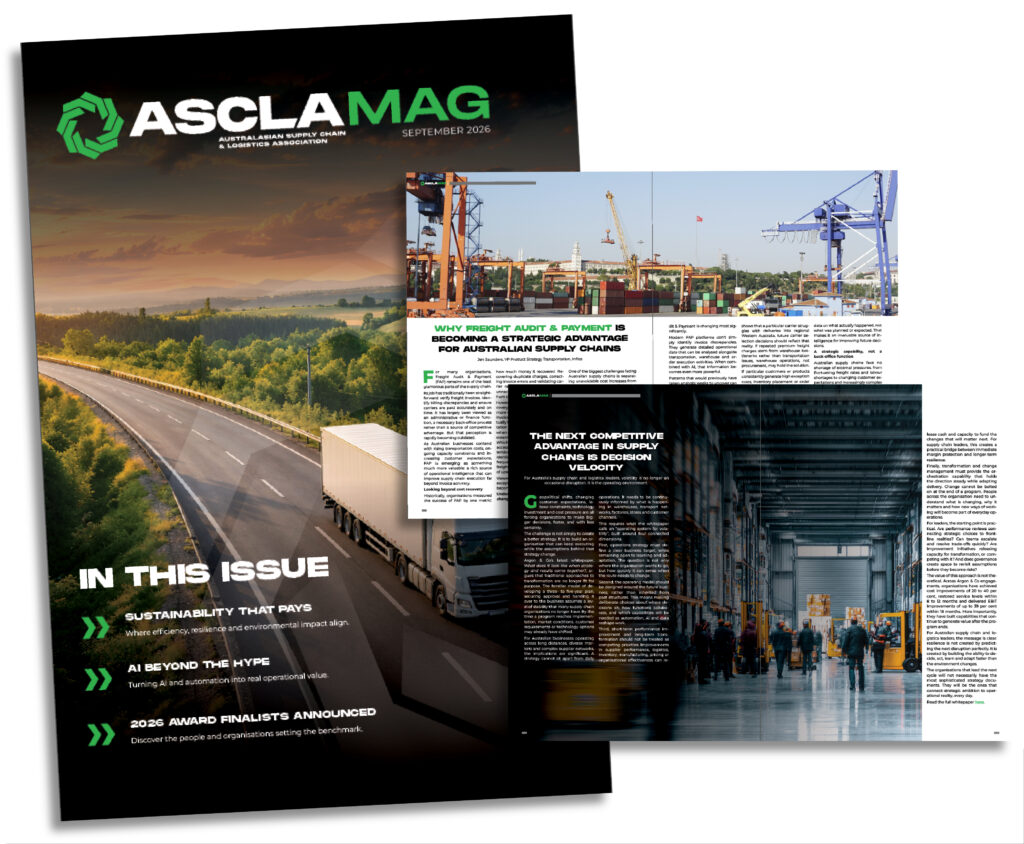
ASCLA Mag September 2026
The September 2026 edition of ASCLA Mag explores how sustainability is becoming a practical business advantage across Australasia’s supply chain and logistics industry. As AI, data and operational innovation reshape how goods are planned, moved and delivered, this edition examines the strategies helping organisations reduce waste, improve efficiency, strengthen freight resilience and build the workforce…

Data Centres and the Squeeze on Logistics Land
By Steven Ballerini | CEO of Australasian Supply Chain & Logistics Association (ASCLA) For most of the past decade, the competition for industrial land on the fringes of Sydney and Melbourne was a contest between logistics operators, manufacturers and the developers who built for them. That contest has acquired a new and considerably better-funded participant.…
Celebrating an Industry That Rarely Celebrates Itself
By Steven Ballerini | CEO of Australasian Supply Chain & Logistics Association (ASCLA) On Friday 23 October the industry will gather at Brisbane City Hall for the ASCLA Industry Awards, and for the first time in more than six decades of the awards the night will be held in Brisbane. Six decades is a long…