
From Reporting to Responsibility: What the Modern Slavery Reforms Mean for Australian Supply Chains

By Steven Ballerini | CEO of Australasian Supply Chain & Logistics Association (ASCLA)
For years, Australia’s corporate response to modern slavery has been largely a paperwork exercise. Large businesses filed annual statements, ticked compliance boxes, and moved on. The Australian Anti-Slavery Commissioner’s initial position paper, published in January 2026, signals that era is coming to an end. The proposed amendments to the Modern Slavery Act 2018 (Cth) represent the most significant shift in supply chain compliance obligations this country has seen. For supply chain and logistics professionals, the implications are direct, operational and unavoidable.
The Commissioner’s two core recommendations are clear: introduce a mandatory, risk-based due diligence obligation for all reporting entities, and create a mechanism to publicly declare certain products, services or industries as carrying a high risk of modern slavery. Together, these reforms would move Australia from a disclosure framework to an action framework. Reporting would still be required. But action would now be compulsory.
Why the Current Framework Has Failed
The position paper is unsparing in its assessment. Despite more than six years of mandatory reporting under the Act, only a small number of entities have disclosed identifying or remediating modern slavery in their supply chains. Compliance-driven, tick-box responses remain the norm. There are currently no penalties for poor-quality reporting and no requirement to actually do anything about risks once identified.
The Commissioner is also direct about Australia’s international standing: once a leader in combating modern slavery, Australia is now falling behind trading partners. The EU, Germany, France, Norway and Switzerland have already enacted mandatory human rights due diligence laws. The United Kingdom is moving in the same direction. The United States, EU, Canada and Mexico expressly prohibit the import of goods made with forced labour. Australia does not. The paper warns explicitly that without reform, Australia risks becoming a dumping ground for goods banned elsewhere.
For supply chain professionals, this international context matters. If your business exports to the EU or supplies companies that do, you will increasingly face due diligence scrutiny from offshore customers and regulators regardless of what Australian law requires. The domestic reform simply formalises what the global market is already demanding.
What the Due Diligence Obligation Will Require
The proposed due diligence obligation applies to all reporting entities with annual consolidated revenue of AUD$100 million or more. A two-year phase-in period is recommended before formal enforcement begins. What it requires is substantive: entities must embed due diligence into governance systems, conduct risk and impact assessments, take action to prevent and address identified risks, track effectiveness, report on actions taken, maintain accessible grievance mechanisms, and engage meaningfully with affected stakeholders.
Critically, the obligation is risk-based and proportionate. It is not designed to impose identical requirements on all businesses regardless of their supply chain complexity or risk profile. Entities with deep exposure to high-risk regions or sectors will be expected to demonstrate more rigorous controls than those with simpler, lower-risk supply chains. The presence of modern slavery in a supply chain will not itself constitute a breach. What will constitute a breach is a failure to take reasonable steps in the circumstances.
For supply chain executives, the practical implications are significant. Supplier screening processes will need to be formalised. Procurement practices will need to consider modern slavery risk as a standing evaluation criterion. Contracts with high-risk suppliers will need modern slavery clauses with real teeth. Board-level governance will need to include regular reporting on modern slavery risk management. And grievance mechanisms will need to be genuinely accessible to workers across the supply chain, not just available on paper.
The High-Risk Declaration Mechanism
The second proposed reform is the introduction of a statutory power for the Commissioner to issue public “high-risk declarations” for specific products, services or industries. Once declared, reporting entities would be required to have regard to those declarations in their due diligence and reporting processes. Ignoring a declared high-risk sector relevant to your operations would constitute a failure of the due diligence obligation and attract regulatory scrutiny.
The paper identifies the top five product categories most at risk as electronics, garments, solar panels, textiles and fish, all sectors with significant representation in Australian import supply chains. Domestic risk areas including horticulture, agriculture, construction, meat processing, cleaning and food services are also specifically called out. Businesses in or adjacent to these sectors cannot afford to wait for declarations before acting. The framework is designed to reward those already doing the work.
The Business Case for Acting Now
The Commissioner’s paper is careful to frame compliance not just as a legal obligation but as a commercial opportunity. A five-year study by the UN Development Programme covering 235 global companies found that every ten-percentage-point improvement in corporate human rights performance correlated with a one percent increase in return on assets. Responsible sourcing, better supplier relationships and reduced legal and reputational exposure are tangible business benefits.
For businesses that have already invested in supply chain mapping, supplier engagement and risk-based procurement, the proposed reforms are not a burden. They are a levelling of the playing field. Competitors who have been cutting corners on compliance will now face the same obligations. The Commissioner’s paper makes this explicit: a due diligence obligation is unlikely to require significant changes for businesses already meaningfully responding to the Act. But it will require real change from those who have not.
There is also a strategic risk angle that deserves attention. As the US, EU and others tighten forced labour import controls, supply chains that cannot demonstrate clean sourcing face increasing market access risk. Businesses supplying into regulated markets or working with global customers subject to overseas due diligence laws will need to satisfy those requirements regardless. Building that capability now is commercially sensible, not just regulatory compliance.
What Supply Chain Leaders Should Be Doing Now
The consultations being run by the Attorney-General’s Department are continuing into early 2026. Legislation may still be some time away, and a two-year phase-in is proposed once enacted. But that timeline is not a reason for inaction. The direction of travel is unambiguous and the lead time required to build genuine capability is substantial.
ASCLA encourages members to use this window constructively. Conduct a supply chain risk assessment if you have not already done so, with specific focus on the high-risk product and sector categories flagged in the Commissioner’s paper. Review your supplier screening and onboarding processes and assess whether modern slavery risk is genuinely embedded in procurement decision-making or simply documented in policy. Engage your board and senior leadership on the governance expectations that a due diligence obligation will formalise.
The paper also encourages industry collaboration. The Commissioner’s Office has worked with the ACCC to provide guidance on modern slavery-related collaborative activities that are low-risk from a competition perspective. Sector-based collaboration on shared supply chain risks is explicitly encouraged. For industry associations, this is an opportunity to lead.
The Final Word
Modern slavery is not an abstract ethical issue for supply chain professionals. It is embedded in the sourcing decisions, supplier relationships and procurement systems that define how our industry operates every day. An estimated 27.6 million people are living and working in forced labour globally, with more than half concentrated in the Asia-Pacific region — precisely where many Australian supply chains source goods and services.
The Commissioner’s position paper is a serious and substantive document. It is pragmatic in its design, proportionate in its expectations and clear in its intent. Australia has an opportunity to build supply chain regulation that is both ethically meaningful and commercially coherent. The proposed reforms do not ask businesses to do the impossible. They ask businesses to take reasonable action in proportion to their risk exposure.
Supply chains built on exploitation are not resilient supply chains. They carry legal risk, reputational risk and the growing risk of market exclusion as global standards tighten. Building compliance capability now is not just the right thing to do. It is the commercially rational response to where the world is heading.
We encourage all members to review the Commissioner’s initial position paper in full and to participate in the consultation process before it closes.
Reference Links
Australian Anti-Slavery Commissioner — Initial Position Paper (January 2026)
Modern Slavery Act 2018 (Cth) — Australian Government
https://www.legislation.gov.au/Details/C2018A00153
McMillan Review — Statutory Review of the Modern Slavery Act 2018 (2023)
https://www.ag.gov.au/crime/publications/report-statutory-review-modern-slavery-act-2018-cth
Surya Deva — Options for Action: Building an Effective Response to Modern Slavery in Australia (December 2025)
EU Regulatory Developments on Human Rights: Implications for Australian Businesses — OAASC & Norton Rose Fulbright (September 2025)
UNDP — Human Rights vs. Competitiveness: Data on the Financial Implications of Corporate Human Rights Performance (2025)
https://www.undp.org/publications/human-rights-vs-competitiveness-false-dilemma
ILO Global Estimates of Modern Slavery: Forced Labour and Forced Marriage (2022)
Walk Free — The Global Slavery Index 2023
https://cdn.walkfree.org/content/uploads/2023/05/17114737/Global-Slavery-Index-2023.pdf
ACCC — Sustainability Collaborations and Australian Competition Law (2025)
View Similar Blogs
ASCLA Mag September 2026
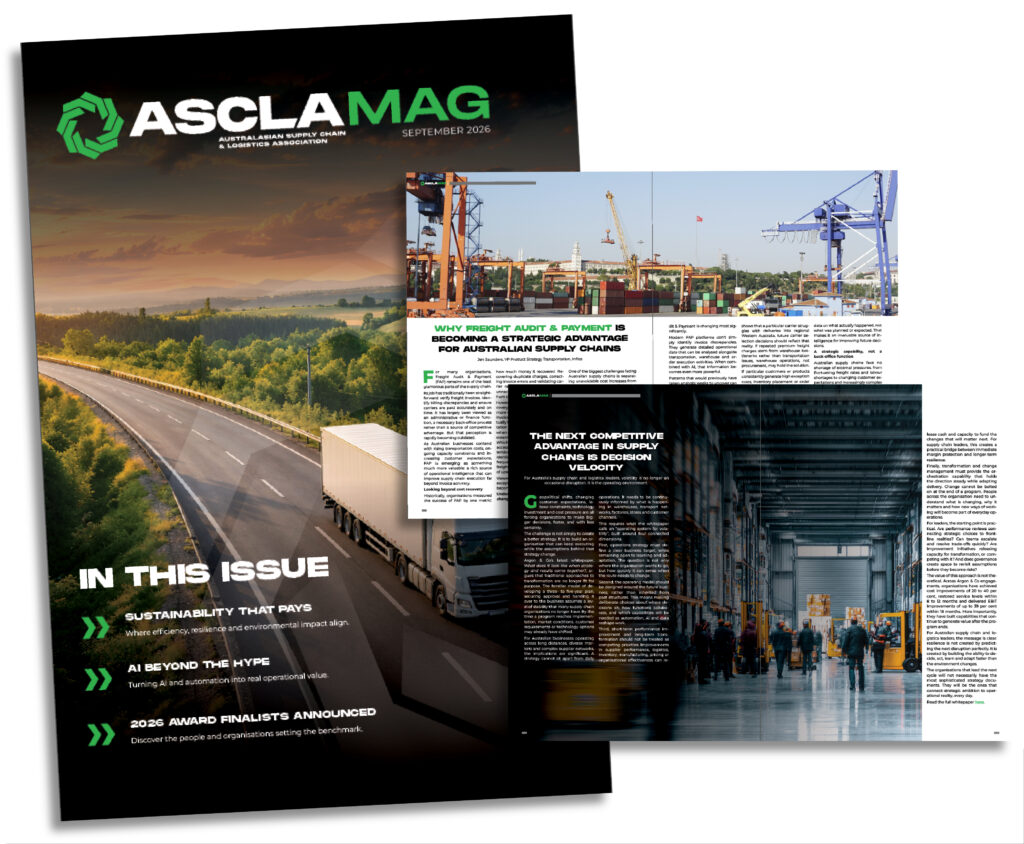
The September 2026 edition of ASCLA Mag explores how sustainability is becoming a practical business advantage across Australasia’s supply chain and logistics industry. As AI, data and operational innovation reshape how goods are planned, moved and delivered, this edition examines the strategies helping organisations reduce waste, improve efficiency, strengthen freight resilience and build the workforce…

Data Centres and the Squeeze on Logistics Land
By Steven Ballerini | CEO of Australasian Supply Chain & Logistics Association (ASCLA) For most of the past decade, the competition for industrial land on the fringes of Sydney and Melbourne was a contest between logistics operators, manufacturers and the developers who built for them. That contest has acquired a new and considerably better-funded participant.…
Celebrating an Industry That Rarely Celebrates Itself
By Steven Ballerini | CEO of Australasian Supply Chain & Logistics Association (ASCLA) On Friday 23 October the industry will gather at Brisbane City Hall for the ASCLA Industry Awards, and for the first time in more than six decades of the awards the night will be held in Brisbane. Six decades is a long…