

Rising Tension in the Middle East: What It Means for Global Shipping

By Steven Ballerini | CEO of Australasian Supply Chain & Logistics Association (ASCLA)
Escalating military action in the Middle East has once again brought global trade routes into sharp focus. Following coordinated strikes on Iranian targets and Tehran’s subsequent response, the Strait of Hormuz has become the epicentre of concern for energy markets and maritime operators alike. What makes this development particularly significant is not just the geopolitical rhetoric, but the reported suspension of oil and LNG shipments through one of the world’s most critical shipping corridors.
Recent reporting in the Australian Financial Review indicates that major oil and gas suppliers have paused transits through the Strait of Hormuz amid heightened security concerns. Tankers have delayed departures, altered course or remained at anchorage rather than risk navigating a waterway now viewed as unstable. While no formal legal closure has been declared, commercial shipping decisions are being made on the basis of safety and risk exposure rather than diplomatic technicalities.
For global shipping markets, this shift from theoretical risk to operational disruption is material.
The Strait of Hormuz: A Critical Artery of Global Trade
The Strait of Hormuz carries roughly one-fifth of the world’s seaborne crude oil and a substantial share of global liquefied natural gas exports. It is a narrow but strategically indispensable corridor connecting Gulf producers with major consuming economies across Asia and Europe.
When traffic through this waterway slows or pauses, the impact is immediate. Energy supply tightens. Market volatility increases. Freight markets react.
Even short-term hesitation in tanker movements can distort prompt supply, particularly when global inventories are not excessive. Asian LNG buyers are especially exposed, given their reliance on Gulf cargoes. For import-dependent economies, any interruption in Hormuz traffic is more than symbolic. It affects real supply chains.
Oil, Equity Markets, and the Risk Premium
Financial markets have already begun pricing in a geopolitical risk premium. The AFR reports that oil prices are tipped to surge following the strikes, with analysts warning that sustained disruption could push crude materially higher. Gold and defence stocks have also rallied, reflecting a shift in investor positioning toward safe havens and security-linked assets.
For shipping, this has two immediate implications.
First, higher oil benchmarks flow directly into bunker fuel costs. Fuel remains one of the largest operating expenses for container lines, bulk carriers, and tanker fleets. An upward movement in crude prices translates quickly into voyage cost recalculations and fuel adjustment surcharges.
Second, volatility influences freight negotiations. Charterers and cargo owners operating in uncertain pricing environments often seek shorter contract durations or more flexible terms. This can contribute to rate fluctuations across shipping segments.
Direct Impacts on Tanker and LNG Markets
The most visible consequence of the current tension is in tanker markets. When vessels delay or avoid transiting Hormuz, effective fleet capacity tightens. Ships that would normally complete a round voyage within a defined window may instead remain idle or reposition elsewhere.
Insurance premiums are also recalibrating. War risk surcharges increase when hostilities intensify near major sea lanes. These additional costs are typically passed on through freight rates.
If rerouting becomes necessary, the cost implications deepen. Alternative pathways add time and distance. Longer voyages reduce annual vessel utilisation and constrain global capacity. Even if the Strait is not formally closed, perceived insecurity can create similar economic outcomes.
LNG shipping faces comparable dynamics. Cargoes are often tightly scheduled to meet downstream regasification and power generation demand. Delays disrupt not just maritime logistics but domestic energy markets in importing nations.
Broader Shipping and Supply Chain Consequences
While crude and LNG carriers are at the forefront, the ripple effects extend across global trade.
Container shipping may not rely directly on the Strait of Hormuz to the same extent, but regional instability influences network planning and risk assessments. Carriers that have only recently stabilised schedules following disruptions in the Red Sea now face renewed geopolitical uncertainty.
Dry bulk markets are affected indirectly through fuel costs and broader economic sentiment. Iron ore, coal and grain exporters operate within tight cost margins. Rising voyage expenses and insurance premiums compress profitability unless passed through to buyers.
The AFR has also highlighted the inevitability of increased petrol prices for consumers. This matters for freight markets because higher refined fuel costs increase inland transport expenses across road and rail networks. For Australian businesses, the compounding effect of higher sea freight and domestic logistics costs can be significant.
Inflation and the Macroeconomic Overlay
An extended period of elevated oil prices would complicate the global inflation outlook. Many central banks had begun to see moderation in price pressures. A renewed energy shock could reintroduce upward pressure on inflation expectations.
For trade-exposed sectors, this creates additional uncertainty. Contract pricing becomes more complex. Demand forecasting is challenged. Investment decisions may be deferred.
Shipping markets rarely operate independently of broader economic cycles. When energy prices rise sharply, the effect is felt across manufacturing, agriculture, and consumer goods. In that sense, tension in a narrow waterway in the Middle East can influence cost structures in ports and warehouses on the other side of the world.
Strategic Implications for Australian Trade
For Australia, developments in the Strait of Hormuz may appear geographically distant but are economically immediate. The country depends heavily on maritime trade for both exports and essential imports. Higher freight rates and fuel costs affect mining operations, agricultural producers, and retail supply chains.
This episode reinforces the importance of supply chain resilience. Diversification of sourcing, careful review of fuel exposure, and strong contractual risk management are no longer theoretical exercises. They are commercial necessities.
Much will depend on whether the current escalation is short-lived or prolonged. Markets can absorb brief disruptions. Sustained uncertainty embeds higher cost structures and reduces planning visibility.
The Final Word
The Strait of Hormuz is a narrow passage with outsized influence on global trade. When confidence in its stability falters, shipping markets respond immediately. Freight rates adjust, insurance premiums rise, and fuel costs increase.
The latest escalation in the Middle East is a reminder that geopolitical risk is not an abstract concept for the logistics sector. It is a live operational variable that shapes cost, capacity, and commercial strategy in real time.
Preparedness, flexibility, and disciplined risk management will define how well the global shipping community navigates this moment. Stability cannot be assumed. Resilience must be built.
View Similar Blogs
Why Transport Belongs at the Centre of Australia’s Innovation Agenda
By Steven Ballerini | CEO of Australasian Supply Chain & Logistics Association (ASCLA) In August, ASCLA joined 23 other national organisations spanning rail, road, heavy vehicles, freight, logistics, engineering and research in a joint letter to Senator the Hon Tim Ayres, Minister for Industry and Innovation and Minister for Science, asking the Australian Government to…
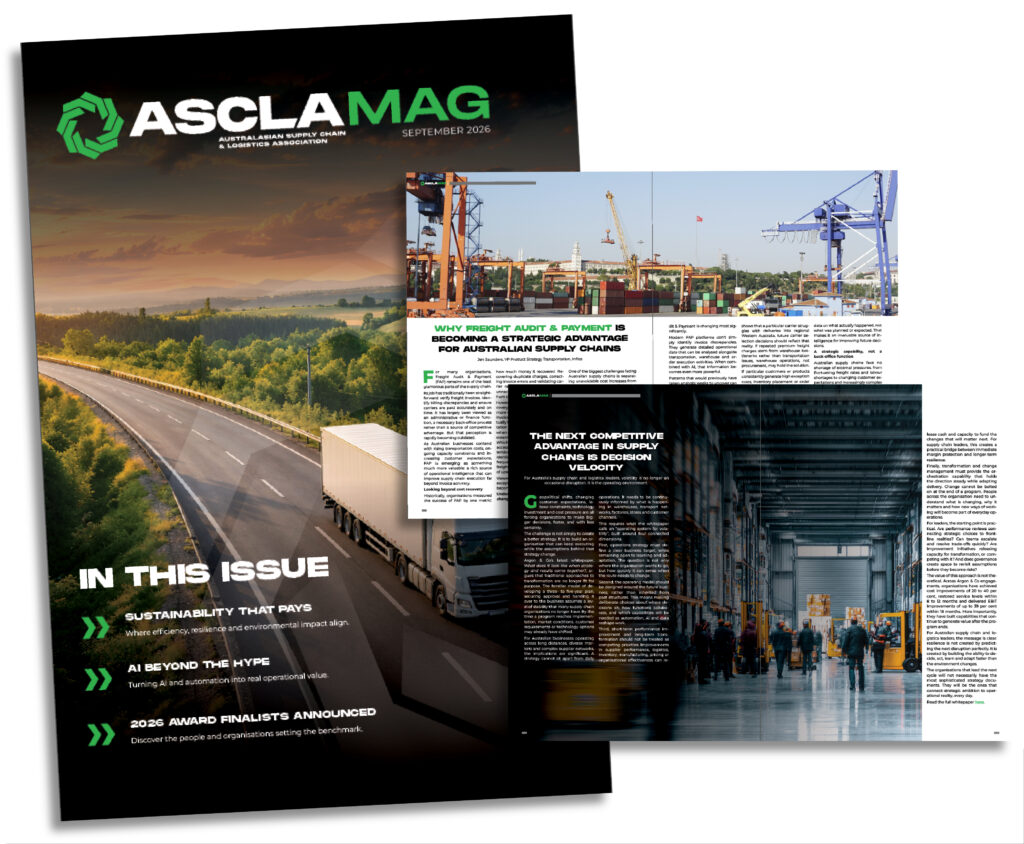
ASCLA Mag September 2026
The September 2026 edition of ASCLA Mag explores how sustainability is becoming a practical business advantage across Australasia’s supply chain and logistics industry. As AI, data and operational innovation reshape how goods are planned, moved and delivered, this edition examines the strategies helping organisations reduce waste, improve efficiency, strengthen freight resilience and build the workforce…

Data Centres and the Squeeze on Logistics Land
By Steven Ballerini | CEO of Australasian Supply Chain & Logistics Association (ASCLA) For most of the past decade, the competition for industrial land on the fringes of Sydney and Melbourne was a contest between logistics operators, manufacturers and the developers who built for them. That contest has acquired a new and considerably better-funded participant.…