

The Evolution of Cargo Theft

By Steven Ballerini | CEO of Australasian Supply Chain & Logistics Association (ASCLA)
Cargo theft is not new. For as long as goods have moved through ports, along highways, and across borders, there have been those looking to steal them. Traditionally, the risk was physical. Trailers were broken into. Loads were intercepted. Warehouses were targeted.
That threat has not disappeared, but the method is changing. Increasingly, cargo crime is being executed through deception rather than force. The target is no longer just the truck or the container. It is the transaction itself.
Recent industry data underscores the scale of the issue. In North America alone, reported cargo theft incidents reached more than 3,600 cases in 2024, an increase of around 25 to 30 per cent on the prior year. Estimated losses were close to US 450 million, with broader industry assessments suggesting the total economic impact runs into the billions annually once indirect costs are included.
More concerning is the value per incident. Average losses per theft have climbed significantly, in some cases exceeding US 250,000 per load, reflecting a deliberate focus on higher value freight. This is not an opportunistic crime. It is organised and increasingly sophisticated.
From Opportunistic Theft to Strategic Fraud
Historically, cargo theft tended to exploit physical vulnerabilities. Criminals monitored unsecured yards or followed high-value loads. They relied on timing and access.
Today, many organised groups are bypassing those risks entirely. Instead of stealing freight in transit, they are securing it through fraudulent contracts. They pose as legitimate carriers or brokers, provide what appear to be valid credentials, and win the right to collect goods lawfully. Once the freight is released, it disappears.
Technology has made this easier. Artificial intelligence tools can generate convincing company profiles, draft professional communication, and create documentation that appears authentic. Websites can be built quickly. Branding can be replicated. Industry terminology can be used accurately and confidently.
The deception is polished. The warning signs are fewer.
Even where overall incident numbers stabilise in some markets, the financial impact continues to rise because criminals are targeting higher value goods such as electronics, food and beverage, pharmaceuticals, and metals. The strategy is simple. Fewer thefts, bigger returns.
The Phantom Carrier Challenge
One of the most troubling developments is the rise of phantom carriers. These are entities that exist online but not in any meaningful operational sense. They may have a website, registration numbers, and a digital history, yet they are created solely for the purpose of intercepting freight.
The ease with which credible identities can now be assembled presents a real challenge for freight operators. In a fragmented industry made up of thousands of small and medium businesses, verification standards vary. Under time pressure, decisions are often made quickly.
That is precisely where organised groups focus their efforts.
The growth in strategic cargo theft has been dramatic in recent years. Some industry bodies have reported that identity-based freight fraud has expanded exponentially, far outpacing traditional trailer theft. The method has shifted from breaking locks to breaking trust.
Digital Impersonation and Social Engineering
Beyond fabricated carrier identities, there is also the risk of impersonation. Digital tools can now replicate writing style and tone with remarkable accuracy. In other sectors, voice replication technology has already been used to authorise fraudulent payments and redirect funds.
In a freight context, it is not difficult to imagine similar tactics being deployed to alter delivery instructions or approve a load release. When communication relies heavily on email and phone contact, familiarity is often treated as verification.
That assumption is becoming increasingly fragile. Supply chains operate on trust. Relationships matter. However, digital trust without layered verification is now a vulnerability.
Why Supply Chains Are Exposed
There are several structural reasons the logistics sector is particularly vulnerable.
First, it is highly decentralised. Thousands of carriers and brokers interact across digital platforms each day. Second, freight moves quickly, and commercial pressure rewards responsiveness. Third, digital marketplaces and load boards have streamlined onboarding but expanded the surface through which criminals can operate.
At the same time, the goods being transported are often high-value and easily resold. That combination creates attractive conditions for organised crime.
Industry estimates suggest that the broader cost of cargo theft, once insurance, disruption, and reputational damage are considered, can exceed US 6 billion annually in some regions. These are not minor losses absorbed quietly. They ripple through contracts, customer relationships, and balance sheets.
The Commercial Consequences
When freight is fraudulently intercepted, the consequences extend well beyond the value of the goods. Insurance claims can be complex when deception rather than force is involved.
Questions arise about due diligence and verification. Customers may demand compensation. Contractual obligations are tested.
In some cases, insurers may tighten underwriting standards or increase premiums in response to rising fraud losses. For operators already managing narrow margins, the financial impact can be significant.
This is no longer simply a warehouse security issue. It is a board-level risk issue.
Strengthening the Response
There is no single fix, but there are practical steps that can reduce exposure. Carrier onboarding processes should include independent verification of registration details and operating history.
Sensitive changes to delivery instructions should trigger mandatory callback procedures using trusted contact information. Multi-factor authentication can be introduced for load releases and account changes.
Training also matters. Staff need to recognise social engineering tactics and understand that polished communication is not proof of legitimacy.
Technology can assist with anomaly detection and identity validation, but culture is equally important. The mindset must shift from assuming authenticity to verifying it.
An Australian Perspective
While much of the publicly reported data comes from overseas markets, the underlying trends are relevant to Australia. As local freight networks become more digitised and integrated with global systems, similar risks will emerge.
Artificial intelligence is delivering real efficiency benefits across supply chains. Forecasting is improving. Routing is smarter. Visibility is increasing. Those advantages are valuable.
However, the same technological progress that enables efficiency can also enable deception. Awareness and governance need to keep pace with innovation.
The Final Word
Cargo theft is evolving from physical interception to strategic digital fraud. Incident numbers are rising in key markets, and the value per theft is increasing sharply. Organised groups are targeting the transactional layer of the supply chain and exploiting digital trust.
The response requires stronger verification, clearer accountability, and closer collaboration across the industry. Freight will continue to move faster and more efficiently in the years ahead. The systems that protect it must evolve just as quickly.
View Similar Blogs
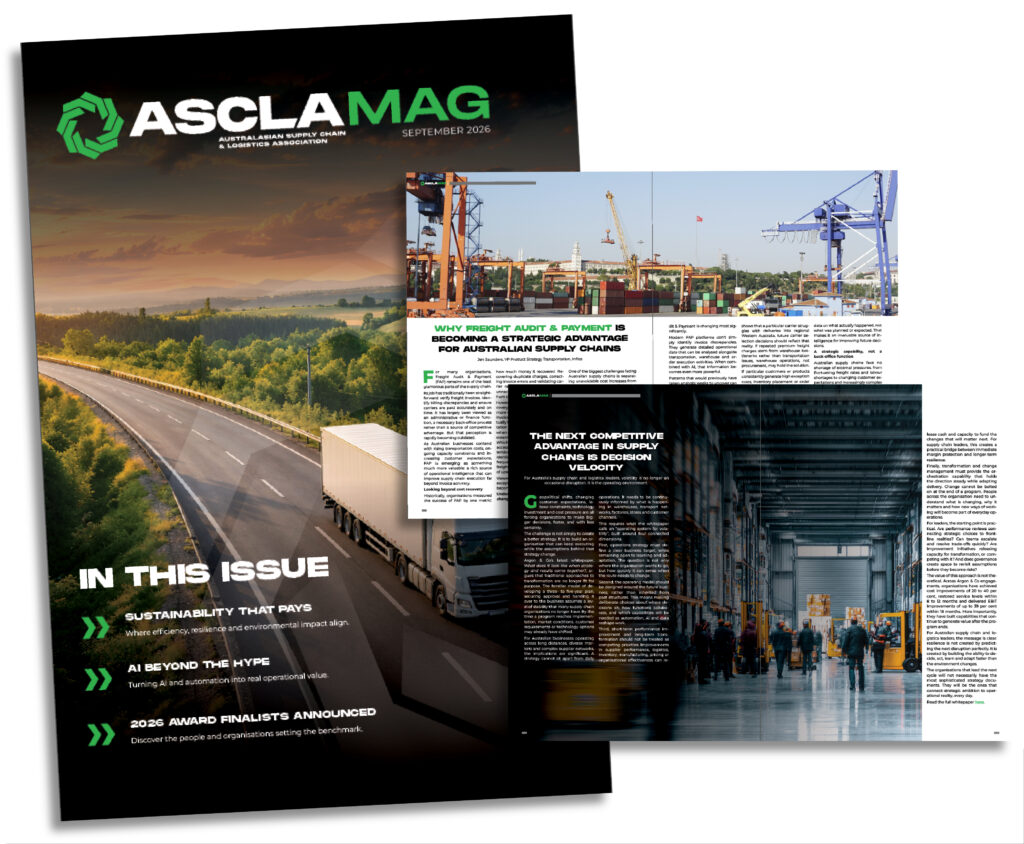
ASCLA Mag September 2026
The September 2026 edition of ASCLA Mag explores how sustainability is becoming a practical business advantage across Australasia’s supply chain and logistics industry. As AI, data and operational innovation reshape how goods are planned, moved and delivered, this edition examines the strategies helping organisations reduce waste, improve efficiency, strengthen freight resilience and build the workforce…

Data Centres and the Squeeze on Logistics Land
By Steven Ballerini | CEO of Australasian Supply Chain & Logistics Association (ASCLA) For most of the past decade, the competition for industrial land on the fringes of Sydney and Melbourne was a contest between logistics operators, manufacturers and the developers who built for them. That contest has acquired a new and considerably better-funded participant.…
Celebrating an Industry That Rarely Celebrates Itself
By Steven Ballerini | CEO of Australasian Supply Chain & Logistics Association (ASCLA) On Friday 23 October the industry will gather at Brisbane City Hall for the ASCLA Industry Awards, and for the first time in more than six decades of the awards the night will be held in Brisbane. Six decades is a long…